An unverified Irish VAT number can cost you real money. Claim input VAT against an invalid supplier number, and Revenue can deny the deduction. Zero-rate a sale to a customer whose number fails validation, and you can end up liable for VAT you never charged.
Verify every number before you invoice. Use VIES, the free validation tool on the European Commission’s VIES portal. VIES stands for VAT Information Exchange System. VAT stands for Value Added Tax. Check the number, save a dated record, then transact. For high supplier volumes, automate the check.
What Is an Irish VAT Number?
An Irish VAT number is a unique identifier issued by the Revenue Commissioners (Revenue) to VAT-registered businesses. It appears on invoices, VAT returns, and official correspondence. Both companies and sole traders receive one when they register for VAT in Ireland. Revenue is the Irish tax authority.
Do not confuse the VAT registration number with the Tax Reference Number (TRN). Revenue issues the TRN when a business first registers for tax, and for a sole trader it matches the Personal Public Service Number (PPSN), per Revenue’s guide to tax registration numbers. The VAT number is that TRN with the “IE” country prefix, used for VAT and cross-border VIES checks.
What Is the Correct Irish VAT Number Format?
An Irish VAT number is “IE” plus 8 or 9 alphanumeric characters. Revenue’s VIES Traders Manual defines it as six digits and two letters, or seven digits and one or two letters. That means a valid legacy number can be shorter than a current one, so never reject an 8-character number as wrong.
| Format | Structure | Illustrative example | Source |
|---|---|---|---|
| Current (since 1 Jan 2013) | IE + 7 digits + 2 letters; second letter is “A” for individuals, “H” for non-individuals | IE1234567AB | Revenue VIES Traders Manual; Revenue eBrief 03/13 |
| Legacy (pre-2013), still valid | IE + 7 digits + 1 letter, or IE + 6 digits + 2 letters with a letter in the second position; legacy “+” or “*” characters may appear | IE1234567A / IE1Z23456A | Revenue VIES Traders Manual |
The examples above are format illustrations, not real registered numbers. See Revenue’s VIES Traders Manual for the authoritative structure.
Why Should You Verify a VAT Number Before Invoicing?
Since the EU’s 2020 quick fixes, a VIES-valid customer VAT number is a substantive condition for zero-rating intra-EU business-to-business (B2B) supplies. EU stands for European Union. Council Directive (EU) 2018/1910 made this rule effective 1 January 2020, per the European Commission’s explanatory notes on the 2020 quick fixes. Get it wrong, and you owe the VAT.
Revenue’s VIES Traders Manual sets three conditions to zero-rate a supply to another EU trader: the customer must be VAT-registered elsewhere in the EU, the supplier must obtain and retain the number, and the number must be quoted on the invoice. Miss any one, and the Irish supplier charges and remits Irish VAT instead.
A valid supplier number also protects your input VAT reclaim, since Revenue can deny a deduction claimed against an invalid number. Verification blocks missing-trader and carousel fraud. A dated VIES record is your audit defense with Revenue.
What Are the Consequences of Using an Invalid VAT Number?
Consequences include denied input VAT recovery, liability for wrongly zero-rated sales, fixed penalties, daily interest, and damaged trust with counterparties. Revenue applies a flat penalty per offence plus interest that runs daily until you pay. The figures below are verified against current Revenue guidance and tied to the offence they attach to.
| Exposure | Amount | Applies to | Source |
|---|---|---|---|
| Fixed penalty | €4,000 per offence | Failure to register as an accountable person, issuing a VAT invoice while unregistered, invoicing non-compliance, failure to file a VAT or VIES return | Revenue.ie fixed penalties |
| Incorrect records penalty | €3,000 careless / €5,000 deliberate | Producing an incorrect VAT invoice, registration number, or credit note | Revenue.ie incorrect records |
| Daily interest | 0.0274% per day (or part of a day) | Unpaid or underpaid VAT, from the due date until paid | Revenue.ie interest guidance |
| Overstated VAT | Full VAT amount shown on the invoice | An invoice showing more VAT than due, until corrected by credit note | Revenue.ie invoices |
How Do You Verify an Irish VAT Number Online with VIES?
Verify Irish VAT numbers on the European Commission’s VIES tool at ec.europa.eu/taxation_customs/vies. VIES checks EU numbers against national databases in real time and returns a valid or invalid result. Revenue’s VIES Traders Manual confirms VIES returns only a yes or no match. It does not return the trader’s name or address for Irish numbers, so do not expect company details.
Follow these steps:
- Open the European Commission’s VIES portal.
- Select “Ireland” or enter “IE” as the member state.
- Enter the full number, including the IE prefix.
- Submit and read whether the number is valid.
- Request the consultation number, which is proof of the check for your audit records.
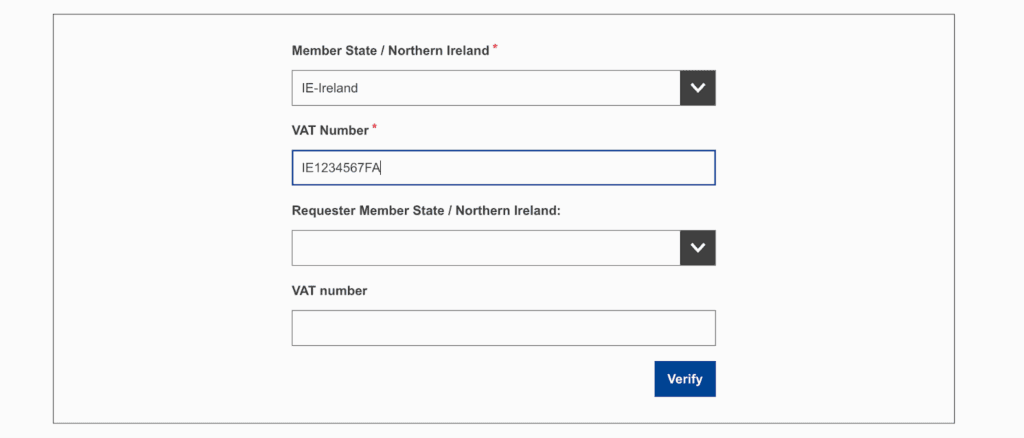
VIES covers EU numbers only. It does not verify UK numbers after Brexit, so use our UK VAT number verification guide for those. Revenue offers no public single-number lookup, and its internal Revenue Online Service (ROS) tool is capped at 10 queries per user per day, so VIES is the route for cross-border checks. For the wider EU context, see our EU VAT number validation guide.
What Are Common Typos in Irish VAT Numbers?
The most frequent failures are missing characters, the wrong country code (GB instead of IE), and misplaced letters. Each one makes a valid number fail on VIES. Rebuild any rejected number against the correct 8-or-9-character format before you retry.
| Typo pattern | Corrected illustrative example | Consequence on VIES |
|---|---|---|
| Missing a digit or letter | IE123456AB → IE1234567AB | Returns invalid; number too short |
| Wrong country code (GB for IE) | GB1234567AB → IE1234567AB | GB numbers are not covered by VIES after Brexit |
| Misplaced or transposed letters | IE12A4567AB → IE1234567AB | Fails the structure check and returns invalid |
| Dropped IE prefix or stray spaces | IE 1234567AB → IE1234567AB | May fail depending on how the field is handled |
What Should You Do If VIES Says Invalid or Inactive?
Recheck for typos first, then retry later, then contact Revenue directly. VIES returns “service unavailable” when a member state database is temporarily down, so a valid number can look unverifiable for a short window. A brand-new number can take 24 to 72 hours to become active. Revenue is the official fallback for inactive or missing records.
| Result | Likely cause | Fix |
|---|---|---|
| Invalid or not recognised | Typo, wrong format, or number not registered | Recheck the format, confirm 8 or 9 characters, and re-enter |
| Inactive or no records found | New number not yet active, deregistered, or a VAT-exempt business with no number | Allow 24 to 72 hours for a new number; contact Revenue to confirm status |
| Service unavailable | Member state database temporarily down | Retry later and keep a dated record of the attempt |
What Are the Current Irish VAT Rates in Ireland?
As of 2026, the standard Irish VAT rate is 23%, with reduced, second-reduced, and zero rates below it. Budget and Finance Act changes periodically move items between rates, so confirm the current assignment on Revenue.ie before you apply a rate.
| Rate | Percentage | Applies to (examples) | Source |
|---|---|---|---|
| Standard | 23% | Most goods and services | Revenue.ie |
| Reduced | 13.5% | Fuel, building services, some tourism activity | Revenue.ie |
| Second reduced | 9% | Certain goods and services, subject to Budget changes | Revenue.ie |
| Livestock / agricultural | 4.8% | Livestock and certain agricultural supplies | Revenue.ie |
| Zero | 0% | Exports, certain food, children’s clothing, oral medicines, and ebooks and audiobooks (since January 2019) | Revenue.ie |
Some sectors are VAT-exempt, including education, financial services, and health. Exempt businesses may legitimately have no VAT number, which explains some failed lookups.
How Can Finance Teams Automate Bulk Irish VAT Number Validation?
VIES has no bulk tool, so accounts payable (AP) teams validating many suppliers use CSV upload or API-based validation. CSV stands for comma-separated values. API stands for application programming interface. VIES exposes a SOAP and a REST API for programmatic checks, which lets you validate hundreds of numbers instead of typing them in one by one.
Manual VIES checks catch a single number at a point in time. Numbers get deregistered, so re-verify before large payments and on a schedule. Commenda’s Global Tax ID Verification tool runs batch checks across countries and keeps a timestamped record for your audit trail, so the whole supplier ledger is validated before a filing rather than one invoice at a time.
How Commenda Automates Irish VAT Verification
Commenda’s indirect tax platform validates customer and supplier VAT numbers, runs bulk checks, and tracks ongoing VAT compliance across the EU. It gives controllers certainty that every number is verified before a return goes out, with a dated record for each check.
Commenda supports 100+ ERP, API, and custom integrations, so validation fits inside your existing accounts payable and invoicing workflows. ERP stands for enterprise resource planning. For related Irish obligations, see our guides on VAT registration for foreign companies in Ireland and import VAT in Ireland.
Book a demo to see every customer and supplier VAT number validated before your next filing.