An invalid Israeli VAT number costs you money. The Israel Tax Authority (ITA) can deny your input Value Added Tax (VAT) credits when a supplier number or invoice is wrong. Poor bookkeeping draws a penalty of 1% of annual turnover under Section 95(a) of the Israeli VAT Law. The minimum is NIS 359 (New Israeli Shekel) per month, effective 1 January 2025. That minimum rose from NIS 350 on 1 July 2024. Late VAT payment adds arrears interest under Section 96, starting at 0.25% of the unpaid tax per week.
This guide gives you a complete, step-by-step process to verify an Israel tax registration number and stay VAT compliant.
What Is an Israeli VAT Number?
An Israeli VAT number is a 9-digit identifier issued by the Israel Tax Authority to a licensed dealer (Osek Murshe). For a company, it equals the Company Registration Number from the Israeli Corporations Authority. For a sole trader, it equals the Teudat Zehut, the national identity number.
The number carries no country prefix. It appears on tax invoices, VAT returns, and ITA correspondence. People sometimes call it the Business Identification Number (BID), but that umbrella term simply points to one of the identifiers below.
Which Tax Numbers Does Israel Use?
Israel uses several overlapping 9-digit identifiers, and the VAT dealer number is only one of them. The table maps each identifier to its issuer and its relationship to the VAT number.
| Identifier | Issuer | Who holds it | Relation to the VAT number | Source |
|---|---|---|---|---|
| Teudat Zehut (9-digit national ID with check digit) | Ministry of the Interior | Israeli citizens and residents | Equals the VAT dealer number for a sole trader | Israel Tax Authority |
| Company Registration Number (9 digits, conventionally starts with 5) | Israeli Corporations Authority (Registrar of Companies) | Incorporated companies | Equals the VAT dealer number for a company | Israeli Corporations Authority |
| Osek Murshe / VAT dealer number (9 digits) | Israel Tax Authority | VAT-charging dealers | The VAT number itself | Israel Tax Authority |
| Income Tax File Number | Israel Tax Authority | Businesses and individuals filing income tax | Separate file, not the VAT number | Israel Tax Authority |
| Tax Deduction File Number | Israel Tax Authority | Employers withholding payroll | Separate file, not the VAT number | Israel Tax Authority |
What Is the Israeli VAT Number Format?
An Israeli VAT number is 9 digits, with no country code, spaces, or hyphens. Incorporated businesses conventionally start with 5, a Registrar of Companies convention rather than a legal rule. Sole traders use their Teudat Zehut, which can start with any digit.
Most rejected numbers fail on simple entry errors:
- Wrong digit count, such as 8 digits instead of 9.
- Added country codes, spaces, or hyphens.
- Transposed digits from manual entry.
- Dropped leading zeros.
How Do You Check the Checksum Offline?
Israeli 9-digit IDs validate against a Luhn-type checksum, so you can catch most typos before any lookup. Multiply each digit alternately by 1 and 2, from left to right. If a product exceeds 9, add its two digits together. Sum every result. A valid number’s total divides evenly by 10.
Does Israel Have a VIES-Style VAT Lookup?
No. Israel has no single free public portal that validates a VAT number by the number alone, unlike the European Union’s VAT Information Exchange System (VIES). Verification in Israel runs through three real channels. Use the Israeli Corporations Authority register, cross-reference the number against the counterparty’s identity, and check the ITA e-invoicing allocation number on qualifying invoices. Our EU VAT number validation guide covers the VIES route for European counterparties.
How Do You Verify an Israeli VAT Number Online, Step by Step?
Confirm the checksum, look the entity up in the Israeli Corporations Authority register, cross-reference the number against the invoice, and confirm active dealer status. There is no one-click portal, so follow each step in order.
- Run the offline checksum check. Confirm 9 digits and a total divisible by 10.
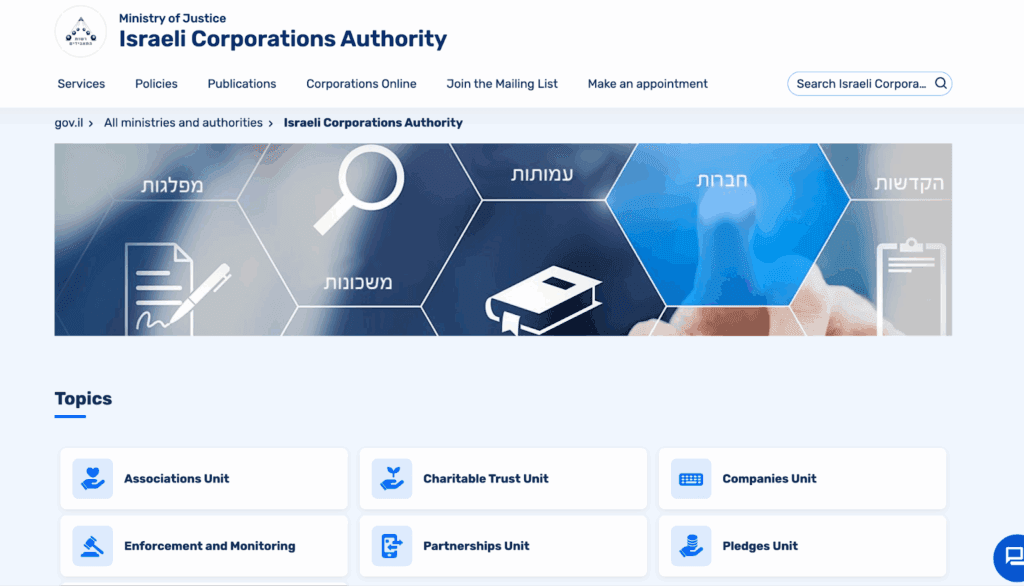
- Search the Israeli Corporations Authority register by company number or name. Check the status, registration date, and legal name. The interface is primarily in Hebrew.
- Cross-reference the identity. The Company Registration Number or Teudat Zehut must match the number and name on the invoice.
- For B2B (business-to-business) invoices above the e-invoicing threshold, treat the ITA allocation number as real-time confirmation.
- Log the result with the date checked, because no portal stores historical status.
How Does Israel’s E-Invoicing Mandate Change VAT Verification?
Israel’s clearance-model e-invoicing requires an ITA-issued allocation number (mispar haktzaa) on B2B tax invoices above a set value. The buyer needs that number before deducting input VAT, per the Israel Tax Authority’s Israel Invoice program. Invoice-level clearance is now the de facto real-time VAT verification tool. The threshold phases down on a published schedule.
| Effective date | Allocation-number threshold (invoice value before VAT) | Source |
|---|---|---|
| From 5 May 2024 | Above NIS 25,000 | Israel Tax Authority (Israel Invoice) |
| 2025 | Above NIS 20,000 | Israel Tax Authority (Israel Invoice) |
| From 1 January 2026 | Above NIS 10,000 | Israel Tax Authority (Israel Invoice) |
| From 1 June 2026 | Above NIS 5,000 | Israel Tax Authority (Israel Invoice) |
What Is the Israeli VAT Registration Threshold?
Israel has no single EU-style registration threshold. NIS 122,833 for 2026 is the ceiling that separates an Osek Patur (exempt small dealer) from an Osek Murshe (licensed dealer). This figure comes from the Israel Tax Authority. It was NIS 120,000 in 2025 and is re-indexed to inflation every 1 January. A dealer must register by the day business activity begins, under Section 52(a). The standard VAT rate is 18%, effective 1 January 2025 (up from 17%), per the Knesset.
| Dealer status | Turnover threshold (2026) | Obligations | Source |
|---|---|---|---|
| Osek Patur (exempt dealer) | Up to NIS 122,833 | Cannot charge VAT, cannot reclaim input VAT, files an annual declaration | Israel Tax Authority (gov.il) |
| Osek Murshe (licensed dealer) | Above NIS 122,833 | Charges 18% VAT, files periodic returns, reclaims input VAT | Israel Tax Authority (gov.il) |
Do Foreign Companies Need an Israeli VAT Registration?
Yes. Non-resident companies with business activity in Israel must register regardless of turnover. Under Section 60(a) of the VAT Law, a non-resident must appoint an Israel-resident representative (fiscal representative) within 30 days of starting activity. They must also file the representative’s written consent with the ITA. That representative is treated as the taxable person and shares liability. See our Israel VAT registration for foreign companies guide for the full process.
What Happens If You Use an Invalid Israeli VAT Number?
You face denied input VAT deductions, penalties, and arrears interest. A missing or invalid allocation number blocks the buyer’s input VAT credit outright. Late registration itself is not a percentage fine; the widely repeated “1% of turnover” figure is actually the Section 95(a) bookkeeping penalty. The table lists each verified penalty with its base, effective date, and source.
| Violation | Penalty and base | Effective date | Source |
|---|---|---|---|
| Failure to keep proper books (Section 95(a)) | 1% of total annual turnover, minimum NIS 359 per month | Minimum effective 1 January 2025 (raised from NIS 350 on 1 July 2024) | Israel Tax Authority (VAT Law) |
| Late payment of VAT (Section 96) | 0.25% of unpaid tax per week for the first six months, then 0.5% per week | Current | Israel Tax Authority (VAT Law) |
| Late filing of a periodic VAT report (Section 94) | NIS 239 per two-week period of delay | Effective 1 January 2025 | Israel Tax Authority (VAT Law) |
| Failure to register when required (Section 117) | Criminal: up to 1 year imprisonment, or up to 5 years with intent to evade tax | Current | Israel Tax Authority (VAT Law) |
| Invalid number or missing allocation number | Buyer’s input VAT deduction denied | Current | Israel Tax Authority (Israel Invoice) |
How Should Finance Teams Check Israeli VAT Numbers for Suppliers?
Verify at onboarding, re-verify quarterly and before large payments, and keep a dated internal log. No Israeli portal stores historical status, so your log is the only audit trail proving a supplier was valid when you paid. Capture the number checked, the Corporations Authority result, the allocation number on large invoices, and the date. This protects your input VAT claim if the supplier is later deregistered.
How Commenda Helps With Israeli VAT Compliance
Commenda’s global indirect tax platform handles Israeli VAT registration, filings, and ongoing compliance monitoring in one place, so your team knows every dealer status and deadline is tracked. It connects to your finance stack through 100+ ERP, API, and custom integrations. Use our global tax ID verification tool to check counterparties at onboarding, and the compliance calendar to stay ahead of filing dates. Expanding into Israel from abroad? Our Israel VAT registration for foreign companies guide walks through the fiscal representative requirement.
Book a demo to get a free Israeli VAT compliance assessment.