Invalid supplier VAT numbers cost you money. They block your input Value Added Tax (VAT) deductions, expose you to penalties, and stall payments with Polish counterparties. Verifying a number before you trust an invoice is the fix.
Three official checks confirm a Polish VAT number. The offline check-digit test proves the number is correctly formed. The gov.pl White List shows domestic VAT status. The European Commission’s VIES VAT number validation portal confirms EU registration. This guide runs all three.
What Is a Polish VAT Number (NIP)?
A Polish VAT number is the Numer Identyfikacji Podatkowej (NIP), Poland’s 10-digit tax identification number issued by the head of the local tax office. Prefixed with PL, it becomes the EU VAT number (PL plus 10 digits). Holding a NIP does not mean the entity is VAT-registered.
The NIP’s structure is set in law. Article 3 of the Act of 13 October 1995 on taxpayer identification defines the NIP as 10 digits: 3 digits for the issuing tax office, 6 for the entity’s sequence number, and 1 check digit. Only entities registered as an active VAT payer (podatnik VAT czynny) carry a live VAT number.
NIP, PESEL, or REGON: Which Poland Tax Registration Number Are You Looking At?
You are looking at a NIP if the counterparty is a business. Since 1 September 2011, individuals without a registered business use their PESEL national personal identification number as their tax identifier instead of a NIP. REGON is a separate statistical number from Statistics Poland (GUS). The tax registration certificate is the document confirming enrollment, not the number itself.
| Identifier | Who holds it | Digits | Issuer | Source |
|---|---|---|---|---|
| NIP | Businesses and self-employed persons | 10 | Head of local tax office | Act of 13 Oct 1995, Art. 3 |
| PESEL | Individuals without a registered business (since 1 Sep 2011) | 11 | PESEL register | Act of 29 July 2011 (Dz.U. 2011 poz. 1016) |
| REGON | All registered entities (statistical use) | 9 or 14 | GUS (Statistics Poland) | GUS statistical register |
What Does It Mean for a Polish VAT Number to Be Valid?
Valid means three distinct things, and each has its own tool. Structural validity means the check digit passes. Domestic VAT status tells you whether the entity is an active payer, exempt, or deregistered. EU VAT registration tells you whether the number works for intra-EU trade. A number can pass one test and fail another.
| Question | What it confirms | Tool that answers it | Source |
|---|---|---|---|
| Is the number correctly formed? | Check digit passes (structural validity) | Offline mod-11 algorithm | biznes.gov.pl |
| Is the entity a VAT payer? | VAT-czynny, VAT-zwolniony, or deregistered | Ministry of Finance White List | Art. 96b VAT Act (Dz.U. 2019 poz. 1018) |
| Is it valid for intra-EU trade? | EU VAT registration | VIES | Council Regulation (EU) 904/2010 |
A passing check digit proves formation only. It never proves the entity is registered for VAT.
What Is the Polish VAT Number Format?
The format is PL followed by exactly 10 digits, with no letters after the prefix and no spaces or hyphens in canonical form. Polish documents sometimes display the number as XXX-XXX-XX-XX, but you enter it without separators. PL2073786728 is a structurally valid format illustration, shown here only to demonstrate the layout.
Most rejected numbers fail on simple entry errors:
- A missing digit (9 digits instead of 10).
- The wrong country code (DE instead of PL).
- Spaces or hyphens left inside the number.
- A dropped PL prefix on an EU lookup.
- Transposed digits, which the check digit usually catches.
How Does the Polish VAT Number Check Digit Algorithm Work?
The NIP uses a weighted modulo-11 checksum. Poland’s official business portal, biznes.gov.pl, documents the NIP check-digit calculation: multiply the first nine digits by the weights 6, 5, 7, 2, 3, 4, 5, 6, 7, sum the products, and take the remainder modulo 11. That remainder is the check digit. A remainder of 10 can never appear in a valid NIP.
Worked example using the illustration NIP 2073786728:
- First nine digits: 2, 0, 7, 3, 7, 8, 6, 7, 2.
- Products against the weights: 12, 0, 49, 6, 21, 32, 30, 42, 14.
- Sum: 206. Then 206 mod 11 = 8.
- The check digit is 8, which matches the 10th digit. The number is well-formed.
This is an offline first-pass filter. It catches typos instantly, before you ever open VIES.
How Do You Verify a Polish VAT Number on the VIES Portal?
Use the European Commission’s VIES tool for EU registration. Select Poland (PL) from the member state list, enter the full number with the PL prefix, and submit. VIES returns valid or invalid, and for Poland it usually shows the registered business name and address. Keep a dated record of every check as audit evidence.
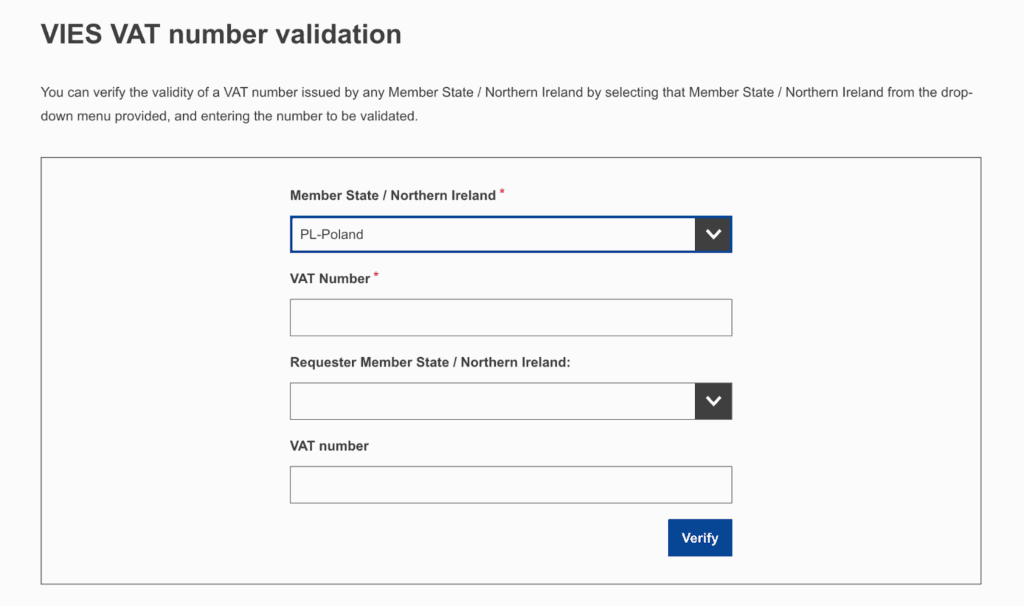
VIES has firm limits, and they are facts, not asides. The web tool checks one number at a time with no bulk upload. It returns current status only, with no historical records. The European Commission’s VIES SOAP API also serves single lookups rather than batch verification. VIES rests on Council Regulation (EU) No 904/2010, the legal basis for cross-border VAT data exchange.
How Do You Check a VAT Number on the Polish Government Portal (Biała Lista)?
Use the Ministry of Finance White List of VAT taxpayers (Biała lista podatników VAT) for domestic status. Search the White List of VAT taxpayers on podatki.gov.pl by NIP, REGON, bank account, or name. It returns active (VAT-czynny), exempt (VAT-zwolniony), or unregistered status, registration dates, and registered bank accounts.
The White List was added as Article 96b of the VAT Act, took effect 1 September 2019, and is maintained by the Head of the National Revenue Administration (Szef KAS), updated on business days. It answers what VIES cannot: whether the domestic entity is a live payer, and which bank accounts are officially registered. A free public API supports programmatic and historical status queries by date.
What Happens If You Use an Invalid Polish VAT Number?
You risk fines, surcharges, and lost deductions. Late or missing VAT registration is a fiscal offense under Poland’s Fiscal Penal Code (Kodeks karny skarbowy, KKS), Article 48 sets the fine as a multiple of the minimum wage, and paying over PLN 15,000 to an unlisted bank account can cost you the deduction entirely.
| Consequence | Amount (2026) | Source |
|---|---|---|
| Fiscal-offense fine for late or no registration | PLN 480.60 to PLN 96,120 (1/10x to 20x the PLN 4,806 minimum wage) | Art. 48 §1 KKS; minimum wage PLN 4,806 from 1 Jan 2026 (Dz.U. 2025) |
| VAT additional liability (understated VAT or overstated input VAT) | 20% to 30% surcharge | Polish VAT Act, Art. 112b |
| White List payment sanction | Loss of the deduction on payments over PLN 15,000 to an unlisted account | Ministry of Finance White List rules (Art. 96b VAT Act) |
| Denied input VAT | Full disallowance of the deduction | Polish VAT Act |
The commonly repeated PLN 260 to 52,000 range is outdated. It was pegged to a PLN 2,600 minimum wage from around 2020. Reputational damage follows too, since counterparties running due diligence drop suppliers whose numbers do not check out.
Who Must Register for VAT in Poland?
Foreign businesses generally must register. A non-resident cannot use the domestic exemption and must register for Polish VAT before its first taxable sale, regardless of turnover, under Article 96(1) of the VAT Act as summarized on biznes.gov.pl. Domestic small businesses can stay exempt below the annual threshold.
| Item | Value | Source |
|---|---|---|
| Standard VAT rate | 23% (since 1 Jan 2011) | Poland Ministry of Finance |
| Reduced rates | 8%, 5%, and 0% | Poland Ministry of Finance |
| EU minimum standard VAT rate | 15% (Poland’s 23% sits 8 points above the floor) | Council Directive 2006/112/EC, Art. 97 |
| Domestic exemption (zwolnienie podmiotowe) | PLN 240,000/year from 1 Jan 2026 (raised from PLN 200,000) | Dz.U. 2025 poz. 896 |
| Prior exemption threshold | PLN 150,000 through 2016, raised to PLN 200,000 on 1 Jan 2017 | infakt.pl |
| EU distance-selling threshold | EUR 10,000 since 1 July 2021 | EU One Stop Shop notes |
The domestic exemption and the EU threshold are separate triggers. The EU-wide EUR 10,000 distance-selling threshold applies to cross-border B2C sales across member states, with the One Stop Shop (OSS) as the reporting alternative. It does not replace the Polish domestic figure.
Why Does a Polish VAT Number Show as Invalid or Inactive?
Usually the number is mistyped, newly issued, or simply not VAT-registered. The White List updates on business days, so a fresh registration can take a short window to appear. A “no record” result often means the NIP exists but the entity is not registered for VAT, so check the White List, not only VIES.
| Result | Likely cause | Fix |
|---|---|---|
| Invalid or not recognized | Typos or a failed check digit | Re-run the mod-11 check, confirm 10 digits after PL |
| Inactive | Newly issued number not yet published | Recheck after the next business-day White List update (roughly 24 to 72 hours) |
| No record found | NIP exists but the entity is not VAT-registered | Check the White List for domestic status |
| Details mismatch | Name or address differs from records | Confirm the registered details on the White List |
| Service unavailable | VIES outage or maintenance | Fall back to the podatki.gov.pl White List |
How Can Businesses Verify Polish VAT Numbers in Bulk?
Manual checks do not scale, so businesses use APIs. VIES has no bulk mode and processes one lookup at a time. The White List API supports programmatic queries with daily limits. Third-party platforms batch-verify entire supplier lists against both sources and monitor status over time.
Commenda’s indirect tax platform automates supplier VAT checks across jurisdictions and connects to your finance stack through 100+ ERP, API, and custom integrations. You can also run one-off lookups with the Commenda global tax ID verification tool during supplier onboarding.
How Commenda Helps You Verify Polish VAT Numbers at Scale
Manual checks break down once you have more than a handful of Polish suppliers. Commenda’s global indirect tax software automates VAT ID validation for suppliers and customers, supports VAT registration and filing, and tracks compliance across every jurisdiction you operate in.
Pair it with the Commenda global tax ID verification tool at onboarding and the Commenda compliance calendar to stay ahead of Polish filing deadlines. Book a demo to get every Polish supplier’s VAT status verified and monitored automatically.