Pay a supplier against an invalid Value-Added Tax (VAT) number and the South African Revenue Service (SARS) can deny your input tax claim, worth 15% of the invoice. That deduction is real money, and the risk sits with the buyer, not the seller.
Here is the verdict up front. Verify any South African VAT number for free on the SARS VAT Vendor Search, and it confirms the number in under a minute. You need two things: the 10-digit VAT number and the exact registered trading name. The tool cross-checks both.
What Is a South African VAT Number and What Format Does It Take?
A South African VAT number is a 10-digit number that always starts with 4, in the form 4XXXXXXXXX. It is purely numeric, with no letters and no country prefix. Only SARS issues it. This differs from European Union (EU) VAT numbers, which carry a two-letter country code such as DE or FR.
| Attribute | Detail | Source |
|---|---|---|
| Length | Exactly 10 digits | SARS VAT Vendor Search documentation |
| Prefix | Always starts with 4 (4XXXXXXXXX) | SARS VAT Vendor Search documentation |
| Characters | Purely numeric, no letters | SARS VAT Vendor Search documentation |
| Example | 4123456789 | SARS |
| Issuing authority | SARS | SARS |
| EU contrast | EU numbers use a 2-letter country prefix (e.g. DE, FR); South Africa uses none | SARS |
Use the “starts with 4, exactly 10 digits” rule as your instant first-pass check. A common typo is entering only 9 digits or dropping the leading 4. Any purported VAT number that fails this rule is invalid on its face, and there is no separate format for individuals versus companies. Every South African VAT number shares this one uniform structure.
How Do You Verify a VAT Registration Number on the SARS VAT Vendor Search?
Verify a VAT registration number on the free SARS VAT Vendor Search. Open the page, accept the terms, choose “Verify a VAT Registration Number,” then enter both the VAT number and the exact registered trading name. Click Search. The tool cross-checks the number against the name and returns a valid or invalid status.
- Go to the official SARS VAT Vendor Search page.
- Accept the terms and conditions, then click Continue.
- Choose “Verify a VAT Registration Number.”
- Enter the VAT number and the registered VAT trading name.
- Click Search to see the valid or invalid status.
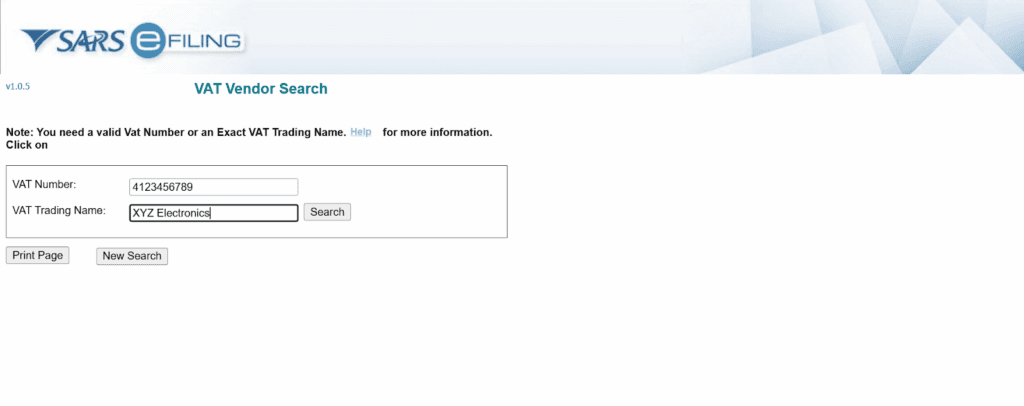
The tool returns a status, not a full company dossier. For non-eFiling users, SARS requires an exact match on the VAT number and trading name to return a result, per the SARS VAT Vendor Search documentation.
Can eFiling Users Run the Search a Different Way?
Yes. Registered eFiling users can run the VAT vendor search from within their eFiling profile and can use partial matches, returning records that start with the entered VAT number or trading name, per SARS. Non-registered users must enter an exact match on both fields.
Can You Look Up a VAT Number by Company Name?
SARS’s own tool needs the VAT number to verify a vendor. For a reverse lookup from company name to number, third-party tools like vatsearch.co.za search by trading name, requiring at least five characters and returning up to 19 possible matches. Treat SARS as the authoritative source. Third-party data can lag, and many CIPC-registered companies hold no VAT number at all.
How Do You Verify a Supplier’s VAT Number Before Payment?
Verify a supplier’s VAT number before you pay. Run the format check, confirm the number on the SARS VAT Vendor Search using the number and trading name from the tax invoice, then keep a dated record of the result. Re-verify quarterly and before large payments. An invalid supplier number can cost you the input tax deduction.
Screening is aggressive on both sides. SARS reported record enforcement in the 2024/25 fiscal year, which underlines why buyers and the revenue authority both scrutinise VAT claims.
| Metric (FY2024/25) | Value | Source |
|---|---|---|
| Gross revenue collected | R2.303 trillion, up 6.9% year on year | SARS 2024/25 revenue results |
| Refunds paid | R447.7 billion, up 8.2% from R413.9 billion | SARS 2024/25 revenue results |
| Impermissible refunds blocked | R146.7 billion | SARS 2024/25 revenue results |
SARS blocked R146.7 billion in impermissible refunds in FY2024/25, per its 2024/25 revenue results. If a supplier’s number is invalid, your input tax claim on that invoice is at risk.
Which Number Did Your Supplier Actually Give You? VAT Number vs. CIPC Number vs. Tax Reference
Check which number your supplier actually handed you. The Companies and Intellectual Property Commission (CIPC) registers companies and issues a company registration number; SARS issues VAT numbers. A CIPC registration number offered as a VAT number is a red flag, not a match. Only a 10-digit number starting with 4 is a VAT number.
| Number type | Issuer | Format | What it proves |
|---|---|---|---|
| VAT number | SARS | 10 digits, starts with 4 | Registered for VAT |
| CIPC registration number | CIPC | Year/serial (e.g. 2015/123456/07) | Company legally exists |
| Tax reference number | SARS | 10-digit taxpayer number | Registered as a taxpayer, not VAT-specific |
A tax registration with SARS is not VAT-specific. Only the 10-digit, 4-prefix number confirms VAT registration.
Who Must Register for VAT in South Africa?
Registration is compulsory once taxable supplies exceed R2.3 million in any consecutive 12-month period, effective 1 April 2026, up from R1 million before that date, per SARS. Voluntary registration opens at R120,000 in the past 12 months, raised from R50,000. Any person carrying on an enterprise can register, including individuals, companies, partnerships, and trusts.
| Item | Current figure | Previous figure | Source |
|---|---|---|---|
| Compulsory registration | Taxable supplies over R2.3 million in any 12 consecutive months (from 1 April 2026) | R1 million | SARS VAT registration threshold FAQ |
| Voluntary registration | Taxable supplies over R120,000 in the past 12 months (from 1 April 2026) | R50,000 | SARS VAT registration threshold FAQ |
| Standard VAT rate | 15% | 15% (2025 hike to 15.5% reversed) | SARS Value-Added Tax page |
A “person carrying on an enterprise” also includes trusts, municipalities, welfare organisations, and notified public authorities. The standard rate stays at 15%, after a Western Cape High Court order on 27 April 2025 suspended the planned increase and SARS directed vendors to reset systems to 15%, per SARS.
Non-compliance carries a 10% penalty on outstanding VAT under section 39 of the VAT Act, plus interest at the prescribed rate, per the SARS Guide for Vendors. That prescribed rate is 10.25% per annum, effective from 1 March 2026, per the SARS interest rate table.
What If a VAT Number Comes Back Invalid or Inactive?
If a number returns invalid or inactive, the cause is usually a typo, a trading-name mismatch, a deregistered vendor, or a CIPC number entered by mistake. Recheck the 10 digits and the 4 prefix, confirm the exact registered trading name, and re-run the search. The table below maps each result to a fix.
| Result | Likely cause | Fix |
|---|---|---|
| Invalid / not recognized | Number not in SARS database, typo, or wrong format | Recheck the 10 digits and the 4 prefix, then re-enter |
| Inactive | Deregistered vendor, or newly issued and not yet processed | Confirm status with SARS; request updated details from the supplier |
| No record found | Trading name does not match the number | Confirm the exact registered trading name (not the marketing name), then retry |
| Trading-name mismatch | Marketing or shortened name entered instead of the registered name | Enter the registered trading name exactly as filed with SARS |
| Wrong length / does not start with 4 | A CIPC company registration number was entered, not a VAT number | Request the correct 10-digit VAT number |
| New number not searchable | Registration not yet activated | Confirm activation with SARS directly |
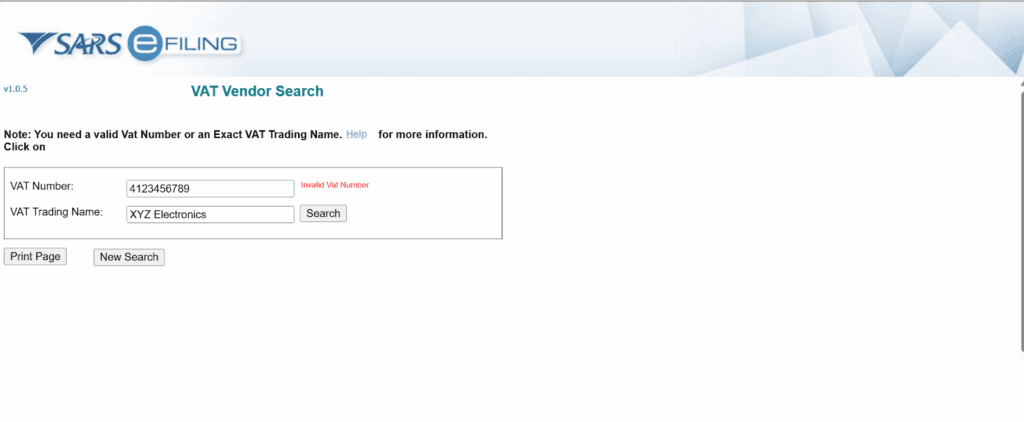
The trading-name mismatch is the most common failure, because the tool cross-checks the name against the number. SARS shows current status only, with no history of status changes, so keep dated internal verification logs as your audit trail. Processing time for new registrations varies, so confirm activation with SARS rather than relying on a fixed window.
Can You Verify a South African VAT Number Through VIES or Other International Tools?
No. The VAT Information Exchange System (VIES) covers EU member states only, and South Africa is not part of it. South African VAT numbers carry no country prefix, so VIES cannot read them. For any cross-border trade with a South African counterparty, the SARS VAT Vendor Search is the only authoritative check.
This is the multi-jurisdiction pain point in one line. Every country runs its own registry with its own format and its own portal, so a finance team verifying suppliers across borders juggles a separate tool per country. There is no single global lookup.
How Commenda Helps You Verify VAT Numbers Across Borders
Commenda’s global indirect tax software handles VAT registration, validation, and filing across jurisdictions, so supplier checks and cross-border compliance run on one platform instead of one government portal per country. Its global tax ID verification tool confirms tax IDs across countries during onboarding and invoicing, and Commenda connects to 100+ ERPs, APIs, and custom integrations so verification fits into your existing accounts-payable workflow.
Book a demo to see how Commenda validates supplier VAT numbers before your next payment run.