You need to verify a company or clear a name before you file, and Tennessee moved its tools. The state’s free lookup now runs through TNBEAR, while filings shifted to a newer portal. This guide shows you where each tool lives and how to read what you find.
Tennessee filed 24,852 new business entities in Q1 2026, up 20.6% year over year and the highest first quarter in the 33-year history of the state’s filing data, per the Tennessee Secretary of State newsroom. At that volume, checking a record before you rely on it is basic diligence.
What Is the Tennessee Business Entity Search?
The Tennessee Business Entity Search is the free lookup tool from the Tennessee Secretary of State, run through TNBEAR (Tennessee Business Entity and Records). It searches registered entities by business name or by Secretary of State control number. Use it to verify a company’s legitimacy, catch name conflicts, and run due diligence before a partnership, investment, or loan.
Tennessee runs three official tools, and mixing them up is the most common mistake.
| Official tool | What it does | Source |
|---|---|---|
| TNBEAR entity search | Searches registered entities by name or control number; no account needed | tnbear.tn.gov |
| TNCaB filing portal | Files annual reports and amendments, orders certificates; launched February 18, 2025 | tncab.tnsos.gov |
| Name Availability Search | Confirms a name is available before you file | Tennessee Secretary of State |
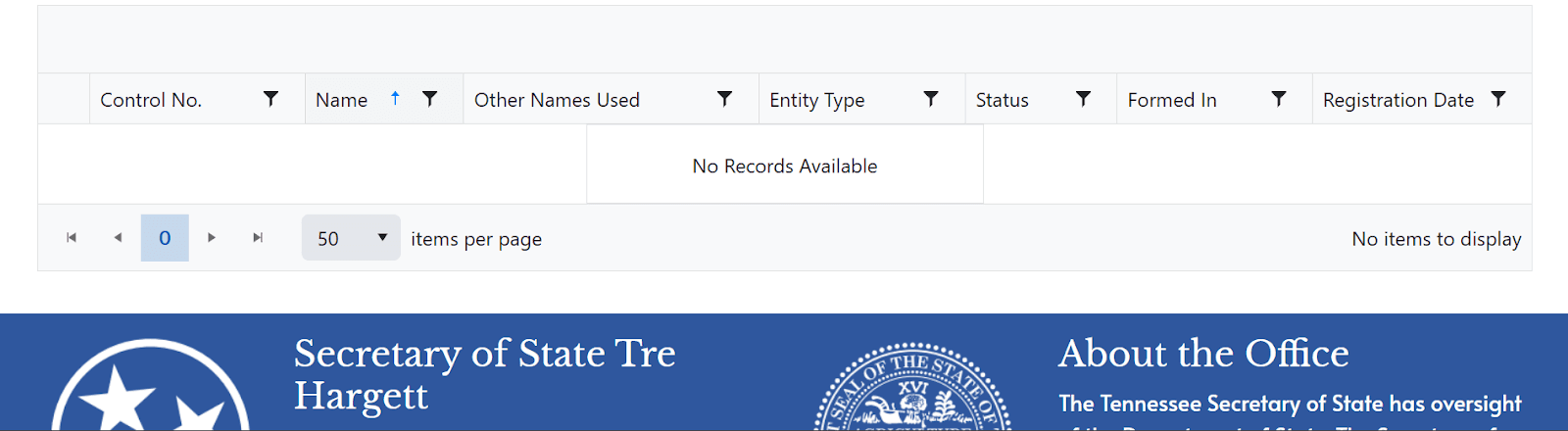
How Do I Search for a Business in Tennessee? (Step-by-Step)
Open TNBEAR, choose a name search or a control number search, then open the record. Name search offers “Starts With” and “Contains”; use “Contains” to catch similar names. A control number search pulls one exact entity by its nine-digit number. No account is required to search, per the Tennessee Secretary of State.
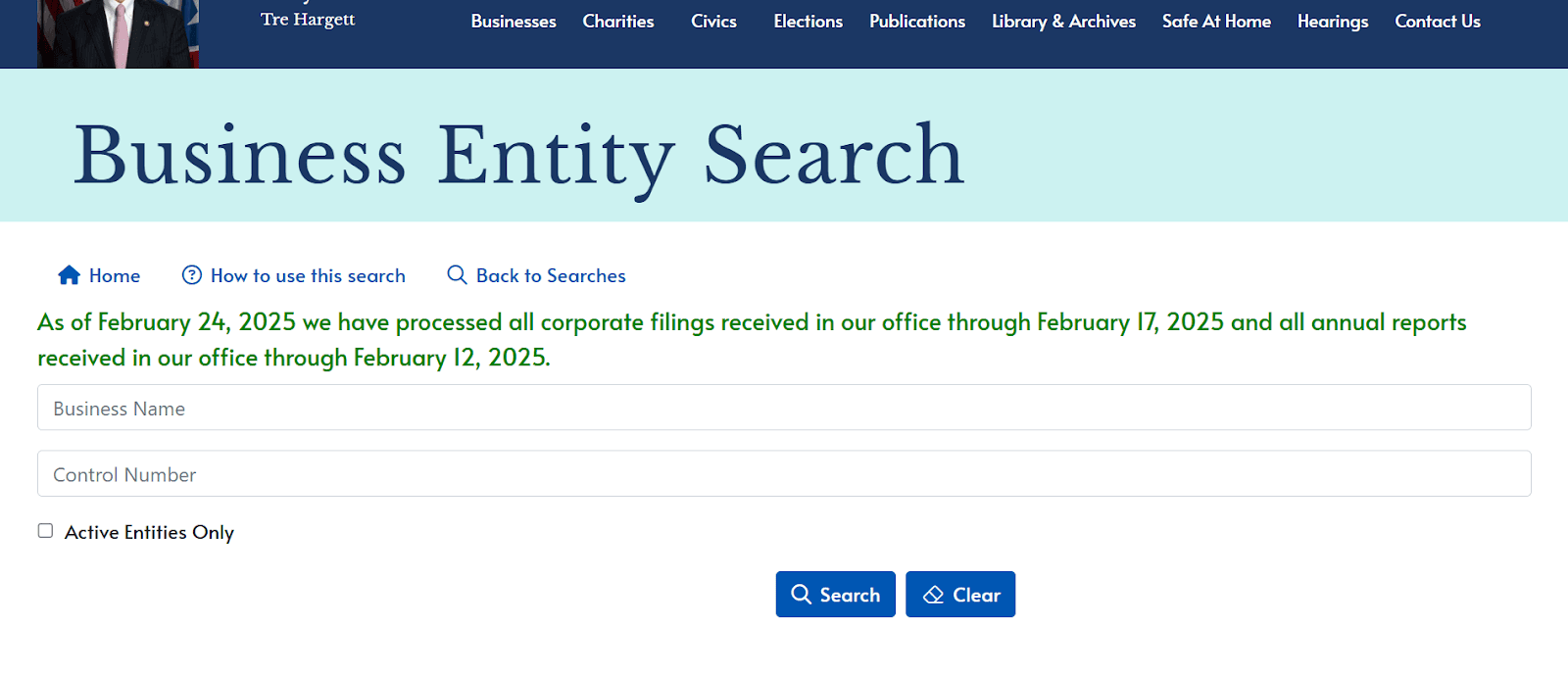
- Open the TNBEAR entity search.
- Enter a business name, or switch to the control number field if you have the nine-digit number.
- For name searches, choose “Starts With” or “Contains”; “Contains” returns more matches.
- Open the matching record to read its status, formation date, registered agent, and filing history.
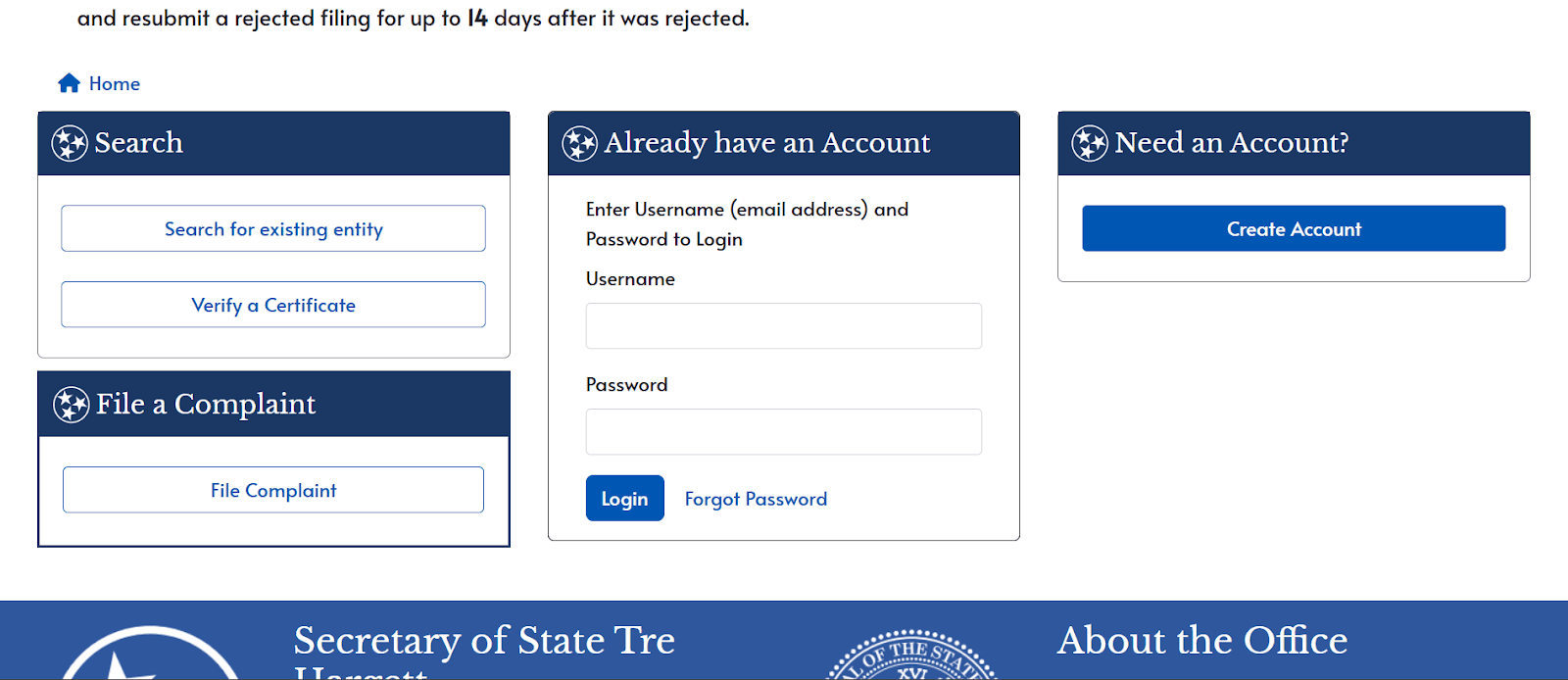
Need help from the state directly? Contact the Tennessee Secretary of State’s office.
What Do the Tennessee Search Results Mean?
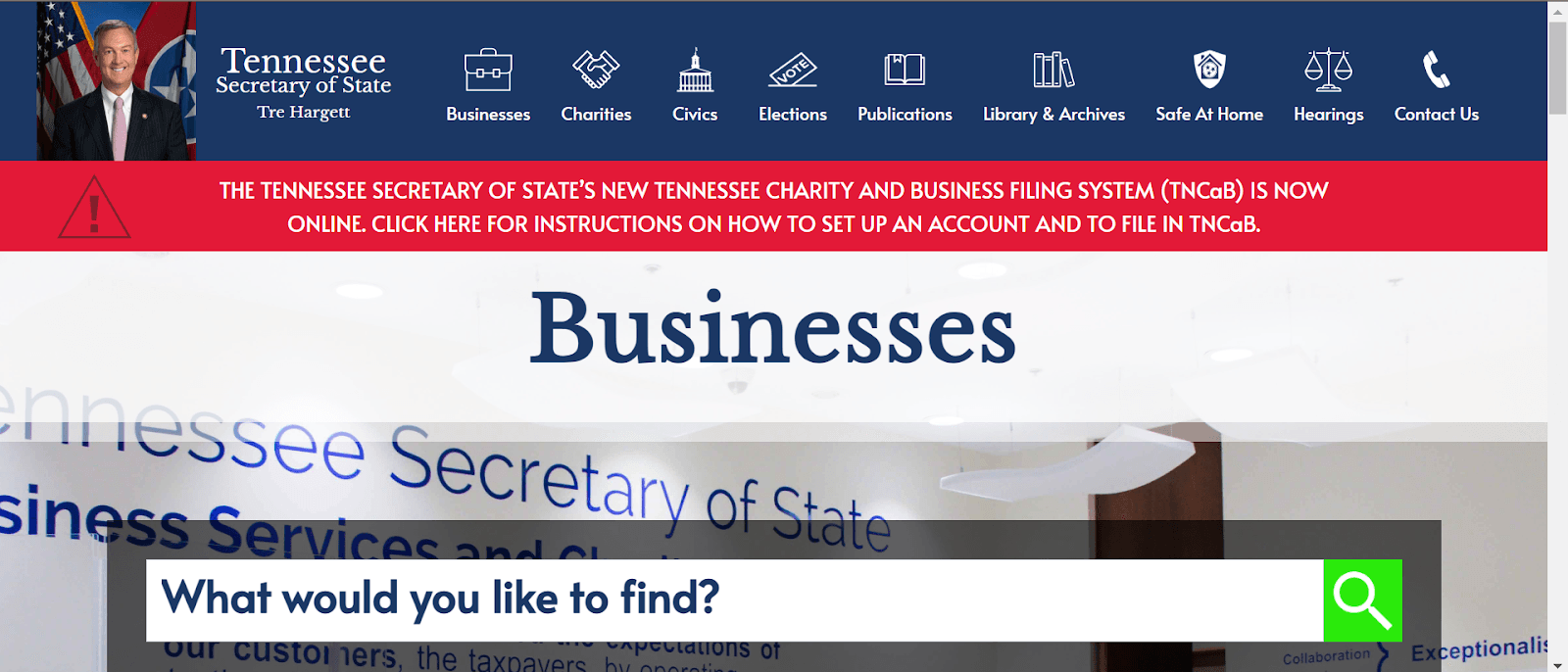
Each result shows the entity’s status, its Secretary of State control number, formation date, registered agent and address, and filing history. The status tells you whether the business is safe to transact with. Every Tennessee corporation, LLC, and limited partnership carries a nine-digit control number, the state file number used to look it up, per TNBEAR. This also answers “is my business registered in Tennessee”: search your name and read the status.
| Status | What it means | What to do |
|---|---|---|
| Active | Registered and current on filings | Safe to transact |
| Inactive | No longer active on the record | Confirm before relying on it |
| Dissolved | Voluntarily wound down by its owners | Treat as closed |
| Administratively dissolved | State revoked it for noncompliance, such as a missed annual report; the entity still legally exists but may only wind up its affairs until reinstated, per Tenn. Code Ann. § 48-249-605 | Ask about reinstatement |
How Do I Check If a Tennessee Business Name Is Available?
Use the Secretary of State’s dedicated Name Availability Search, a separate tool from the general entity search, and confirm your name is distinguishable on the record. A name that differs only by punctuation, capitalization, or an entity tag is not distinguishable. Clear the name here before you spend a filing fee.
What are Tennessee’s naming rules?
LLCs must include “LLC” or “Limited Liability Company”; corporations must include “Inc.” or “Corporation.” Tennessee law requires a name to be “distinguishable upon the records of the secretary of state” from every other registered name, per Tenn. Code Ann. § 48-249-106. If you operate under a different name, file a doing-business-as (DBA), also called an assumed name.
How do I reserve or protect a name?
Reserve a name with the Application for Name Reservation (Form SS-9425) for a $20 fee, which holds it for 120 days, per the Tennessee Secretary of State. For brand protection, register a state trademark with the Secretary of State, or a federal trademark with the USPTO (United States Patent and Trademark Office). Run a fast pre-check with Commenda’s company name checker, then see how to register a business in Tennessee.
Which Business Structures Show Up in a Tennessee Entity Search?
A Tennessee entity search returns corporations, LLCs, limited partnerships (LPs), and nonprofits, each defined by the document it files with the Secretary of State (SOS).
| Structure | Formation document filed with the SOS | Taxation model | Best for |
|---|---|---|---|
| Corporation | Charter (Articles of Incorporation) | Double taxation | Investors and stock issuance |
| LLC | Articles of Organization | Pass-through | Most small businesses |
| LP | Certificate of Limited Partnership | Pass-through | Passive-investor ventures |
| Nonprofit | Nonprofit charter | Tax-exempt (with IRS approval) | Charitable purposes |
Corporations face double taxation but suit companies raising capital from investors. LLCs get pass-through taxation and flexible management. LPs let general partners run the business while limited partners stay passive and shielded. Nonprofits need IRS (Internal Revenue Service) tax-exempt status on top of the state charter. Forming an LLC costs $50 per member, with a $300 minimum and a $3,000 maximum, per Form SS-4270 (revised January 2025) and Tenn. Code Ann. § 48-249-1007(d). A 2025 bill (SB0037) to replace that with a flat fee was withdrawn on January 30, 2025, so the per-member structure stands.
How Do I Get a Certificate of Existence in Tennessee?
Order a certificate of existence through the TNCaB portal. In Tennessee, the certificate of existence is the certificate of good standing: the Secretary of State defines it as a document that “certifies that an entity is active and in good standing.” It is not a certificate of incorporation, a term people use for the formation document, which in Tennessee is the Charter for corporations and the Articles of Organization for LLCs.
How do I order certified copies of business documents?
Request certified copies from the Secretary of State with four details: the SOS control number, the legal business name exactly as listed, the specific documents you want, and your contact information. Certified copies carry legal weight for financing, litigation, and foreign registration, which plain printouts do not.
What Are Tennessee’s Registered Agent Requirements?
Every Tennessee entity except a general partnership (GP) must maintain a registered agent, per the Tennessee Secretary of State. The agent accepts legal mail for the business. Requirements: a physical Tennessee street address (no P.O. box), availability during normal business hours, and either an individual resident or a company authorized to do business in the state. Change your agent by filing through TNCaB.
How Do I Register a Foreign LLC in Tennessee?
An out-of-state entity doing business in Tennessee files for a certificate of authority with the Secretary of State. That application requires a certificate of existence or good standing from your home state, which is exactly what a business entity search verifies on the other end. Confirm current forms and fees on the Secretary of State fee schedule before filing.
Expanding across nearby states? See our Kentucky business entity search and Texas business entity search guides.
When Is the Tennessee Annual Report Due and What Does It Cost?
Tennessee annual reports file through TNCaB, and the state requires you to create a TNCaB account first, per the Tennessee Secretary of State. Reports are due on the first day of the fourth month after your fiscal year closes, which is April 1 for calendar-year filers. The account also saves draft filings for 14 days.
| Entity type | Annual report fee | Source |
|---|---|---|
| LLC | $50 per member, $300 minimum, $3,000 maximum | Tenn. Code Ann. § 48-249-1007(d) |
Tennessee’s per-member LLC fee is unusual, since most states charge a flat annual fee. A ten-member LLC pays $500, while a six-member LLC pays the $300 minimum. Corporations and nonprofits pay flat annual fees; confirm the current amount in your TNCaB account before filing.
What Is the Tennessee Franchise and Excise Tax?
The franchise and excise (F&E) tax is a separate obligation administered by the Tennessee Department of Revenue, not the Secretary of State, a distinction filers routinely confuse. It applies to entities with liability protection, including LLCs, corporations, and LPs. Rates and thresholds change, so confirm current figures with the Tennessee Department of Revenue before you file.
Registering to collect sales tax is also handled by the Department of Revenue; see how to register for a sales tax permit in Tennessee.
How Do I Avoid Third-Party Business Renewal Scams in Tennessee?
Treat unsolicited renewal mail with skepticism, because every Tennessee filing can be done directly and cheaply through TNCaB. The Secretary of State has warned that third-party solicitors send official-looking notices charging inflated fees for annual reports and certificates. If a letter pressures you to pay a private company, verify the requirement in your TNCaB account first, per the Tennessee Secretary of State newsroom.
What Does a Tennessee Compliance Calendar Look Like?
Four obligations keep a Tennessee entity in good standing across a year: the annual report to the Secretary of State, franchise and excise tax to the Department of Revenue, continuous registered agent maintenance, and local business license renewals. The table below maps each to its agency, timing, and source.
| Obligation | Agency | Timing | Source |
|---|---|---|---|
| Annual report | Secretary of State (TNCaB) | First day of 4th month after fiscal year close | TNCaB |
| Franchise and excise tax | Department of Revenue | Per DOR schedule | TN Dept. of Revenue |
| Registered agent | Secretary of State | Continuous | TNCaB |
| Business license renewal | County/city | Local schedule | Tennessee business license guide |
How Commenda Helps With Tennessee Entity Compliance
Commenda’s entity management platform tracks registered agent details, annual report deadlines, and good-standing status across every state and entity from one dashboard. It stores each entity’s Secretary of State control number and registration data, then auto-generates a filing calendar so a missed Tennessee annual report never quietly dissolves your company. Pair it with Commenda’s compliance calendar to see every deadline by state and entity in one view.
Book a demo for a free compliance-calendar review of your Tennessee entities.