Partnerships and multi-member limited liability companies (LLCs) must file Form 1065 every year, even though the partnership itself pays no federal income tax. Miss the deadline and the penalty stacks per partner, per month, up to a year.
This guide covers what Form 1065 is, who files it, when it is due in 2026, the current penalties, and how to file it step by step, including Schedule K-1, foreign partners, and amendments.
Quick answer:
- What it is: Form 1065 is the U.S. Return of Partnership Income, an annual information return, not a tax-paying return.
- Who files: general partnerships, limited partnerships, and multi-member LLCs taxed as partnerships.
- When it is due: the 15th day of the 3rd month after year-end; for 2025 calendar-year returns that is March 16, 2026, per the IRS Instructions for Form 1065.
- Penalty exposure: $255 per partner, per month, up to 12 months, per the IRS failure-to-file penalty guidance.
What Is Form 1065 and Why Does It Matter?
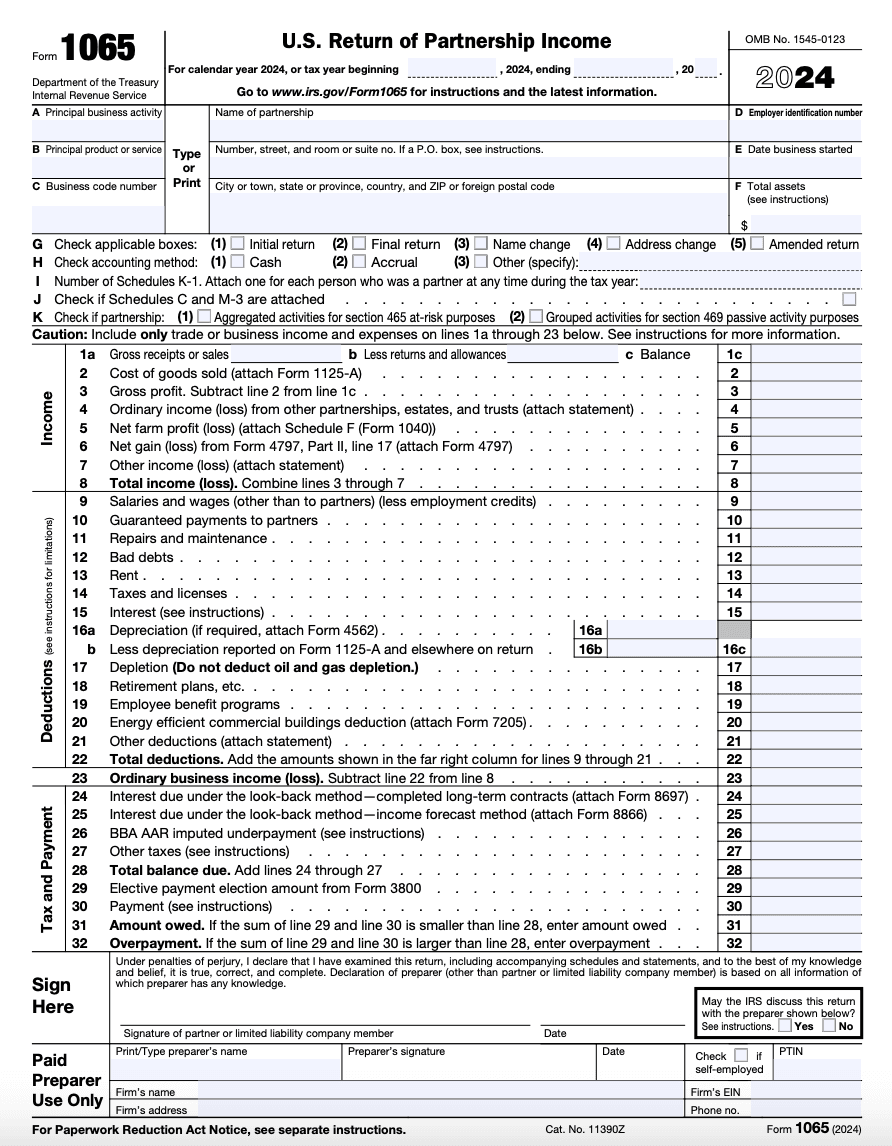
Form 1065 is the U.S. Return of Partnership Income, an annual information return that reports a partnership’s income, deductions, gains, losses, and credits. The Internal Revenue Service (IRS) uses it to see how profit is split, not to collect entity-level tax. Partnerships are pass-through entities, so the numbers flow to the owners.
Under pass-through mechanics, the partnership pays no federal income tax itself. Income and losses flow to partners on Schedule K-1, and the IRS cross-checks the entity totals against each partner’s return. An LLC taxed as a partnership files the same way. See the IRS Instructions for Form 1065 for the full return.
Who Needs to File Form 1065?
General partnerships, limited partnerships, multi-member LLCs taxed as partnerships, and other unincorporated organizations treated as partnerships file Form 1065. Single-member LLCs and entities that elected corporate or S-corp treatment do not. A partnership that neither receives income nor incurs deductible or creditable expenditures for the year is generally not required to file, per the IRS instructions.
| Entity type | Files Form 1065? | Reports instead on | Source |
|---|---|---|---|
| General partnership (GP) | Yes | — | IRS Instructions for Form 1065 |
| Limited partnership (LP) | Yes | — | IRS Instructions for Form 1065 |
| Multi-member LLC (default classification) | Yes | — | IRS Instructions for Form 1065 |
| Single-member LLC | No | Owner’s Schedule C (Form 1040) or corporate return | IRS Instructions for Form 1065 |
| Qualified joint venture (spouses electing out) | No | Each spouse’s Schedule C | IRS Instructions for Form 1065 |
| Entity electing C-corp treatment (Form 8832) | No | Form 1120 | IRS Instructions for Form 1065 |
| Entity electing S-corp treatment (Form 2553) | No | Form 1120-S | IRS Instructions for Form 1065 |
| Partnership with no income and no deductions | Generally no | Not required to file | IRS Instructions for Form 1065 |
How Does an LLC Choose or Change Its Tax Classification?
A domestic multi-member LLC defaults to partnership taxation and files Form 1065 automatically. To change that, the LLC files Form 8832 to elect C-corporation treatment or Form 2553 to elect S-corporation treatment. The election sets which federal return the entity files. A mid-year change creates two short tax years and a final short-year Form 1065.
An S-corp election on Form 2553 is generally due within 2 months and 15 days of the start of the tax year it should take effect, per IRS instructions for the form. When an election takes effect mid-year, the partnership files a final short-year Form 1065 for the period it was still taxed as a partnership, then the new return type covers the rest of the year.
When Is Form 1065 Due?
Form 1065 is due the 15th day of the 3rd month after the tax year ends. For calendar-year partnerships that is March 15, moved to the next business day when it lands on a weekend or holiday. Because March 15, 2026 is a Sunday, 2025 calendar-year returns are timely if filed by March 16, 2026, per the IRS.
| Filer situation | Deadline | Source |
|---|---|---|
| Standard rule | 15th day of the 3rd month after tax year-end | IRS Instructions for Form 1065 |
| Calendar-year partnership (2025 tax year) | March 16, 2026 (March 15 falls on a Sunday) | IRS Instructions for Form 1065 |
| Fiscal-year partnership | 15th day of the 3rd month after fiscal year-end | IRS Instructions for Form 1065 |
| Extended (Form 7004 filed on time) | September 15, 2026 (calendar-year) | IRS Instructions for Form 1065 |
| Schedule K-1 furnished to partners | By the return due date, including extensions | IRS Instructions for Form 1065 |
How Do You Get a Form 1065 Extension With Form 7004?
File Form 7004 by the original due date for an automatic 6-month extension, which moves calendar-year filers to September 15. No reason or signature justification is required, per the IRS Instructions for Form 7004. The extension is automatic once the form is filed on time and correctly.
An extension to file is not an extension to pay. The partnership usually owes no federal income tax, but partners still owe tax on their share at their own deadlines. Any entity-level amounts, such as state taxes or Bipartisan Budget Act (BBA) imputed underpayments, stay due at the original date.
What Are the Penalties for Filing Form 1065 Late?
The IRS charges $255 per partner, for each month or part of a month the return is late, capped at 12 months, for returns due after December 31, 2025. The dollar figure is inflation-indexed and rises most years (it was $245 for 2025 and $220 for 2023, the number many old posts still cite), per the IRS failure-to-file penalty guidance.
| Violation | Penalty amount | Cap | Source |
|---|---|---|---|
| Late or incomplete filing | $255 per partner, per month | 12 months | IRS failure-to-file penalty |
| Failure to furnish a correct Schedule K-1 (and K-3) | $340 per K-1 ($680 if intentional disregard) | $4,098,500 (receipts over $5M) / $1,366,000 (at or below $5M) | IRS information return penalties |
| Failure to e-file when required | Treated as a failure to file | See late-filing row | IRS Instructions for Form 1065 |
Small partnerships can qualify for reasonable-cause relief. Under Revenue Procedure 84-35 principles, a partnership of 10 or fewer partners, each an individual (other than a nonresident alien) or an estate, with proportionate shares, escapes the late-filing penalty if every partner timely reported their share, per IRS Chief Counsel guidance in PMTA 2020-01. Beyond dollars, late filing raises audit risk and strains partners waiting on K-1s.
How Do You File Form 1065 Step by Step?
Gather your records, complete the main form and its schedules, prepare one Schedule K-1 per partner, attach required schedules, file with the IRS, and furnish the K-1s to partners by the deadline. The main form drives Schedule K totals, and those totals feed every partner’s K-1. Work top to bottom so the numbers tie.
What records do you need before you start?
You need the Employer Identification Number (EIN), a profit-and-loss (P&L) statement, a balance sheet, the prior-year return, each partner’s ownership percentages, and capital account records. These feed Page 1, the schedules, and every K-1. Collecting partner Taxpayer Identification Numbers (TINs) early prevents last-minute K-1 errors.
How do you report income, deductions, and your accounting method?
Report ordinary business income or loss on Page 1, subtracting deductible expenses from gross receipts. The partnership declares its accounting method, cash or accrual, on the return. A partnership that carries inventory or has average annual gross receipts above the IRS small-business threshold generally must use the accrual method; verify the current limit in the IRS instructions.
What do Schedules B and K cover?
Schedule B answers other-information questions about ownership, foreign partners, debt, and audit-regime status. Schedule K aggregates the partnership’s total distributive shares of income, deductions, and credits. Schedule K is the source: its totals split across the individual K-1s, so Schedule K and the sum of all K-1s must match exactly.
How do you file and furnish K-1s?
E-file through the IRS or mail the return to the address in the current instructions, then furnish each partner their Schedule K-1 by the return deadline. Retain the return, K-1s, and supporting records for at least three years. Most partnerships must now e-file, so confirm your requirement before printing anything.
How Do You Complete Schedules L, M-1, and M-2?
Schedule L is the balance sheet per books, Schedule M-1 reconciles book income to tax income, and Schedule M-2 analyzes partners’ capital accounts. They must tie to each other and to the K-1s. A partnership that answers “yes” to the Schedule B small-partnership question is exempt from all three, so many small filers skip them.
| Exemption condition | Threshold | Source |
|---|---|---|
| Total receipts for the tax year | Less than $250,000 | IRS Instructions for Form 1065 |
| Total assets at year-end | Less than $1,000,000 | IRS Instructions for Form 1065 |
Both thresholds must be met (along with timely K-1s and other Schedule B conditions) to waive Schedules L, M-1, and M-2. Verify the current figures in the IRS instructions before relying on the exemption.
How Do Capital Accounts Work on Form 1065?
A capital account tracks each partner’s equity: contributions in, allocated income and losses, and distributions out. The IRS requires K-1 capital accounts on the tax-basis method, an enforcement change that trips up filers still using book or generally accepted accounting principles (GAAP) basis, per the IRS Instructions for Form 1065.
The rollforward is simple: beginning capital, plus contributions, plus allocated income, minus distributions, minus allocated losses, equals ending capital. Those ending balances must reconcile to Schedule M-2 in aggregate and to each partner’s K-1 Part II. When they do not tie, the return draws IRS attention.
How Do You Fill Out Schedule K-1 (Form 1065)?
You prepare one Schedule K-1 per partner, in three parts. Part I lists partnership information and the EIN. Part II covers partner identity, partner type (general or limited, domestic or foreign), profit, loss, and capital percentages, and the capital account analysis. Part III reports the partner’s coded share of income, deductions, and credits.
Two IRS instruction sets apply, and readers confuse them. The partnership follows the IRS Instructions for Form 1065 to prepare K-1s. Each partner follows the separate Partner’s Instructions for Schedule K-1 to report the K-1 on their own return. The coded boxes in Part III point to attached statements that explain each amount.
How Does Schedule K-1 Affect a Partner’s Tax Return?
Partners report their distributive share on their own returns whether or not cash was actually distributed. That is what pass-through means: the tax follows the allocation, not the payout. A partner who received no cash can still owe tax on allocated income, so K-1 timing matters for every partner’s planning.
Do partners owe self-employment tax on K-1 income?
General partners and active LLC members typically owe self-employment tax on their share of ordinary business income, reported in the K-1 self-employment earnings box. Limited partners generally do not owe self-employment tax on their distributive share. Guaranteed payments for services are generally subject to self-employment tax; verify current rules in the IRS instructions.
How Do K-1 Allocations Change a Partner’s Basis?
A partner’s outside basis rises with contributions and allocated income and falls with distributions and allocated losses. Partners need accurate basis to deduct losses and to compute gain or loss when they sell their interest. Basis tracking is the partner’s own responsibility, not the partnership’s, per the IRS instructions.
Losses beyond a partner’s basis are suspended and carry forward until the partner has enough basis to use them. A partner who deducts losses without tracking basis risks disallowed deductions and an amended return later.
When Are Schedules K-2 and K-3 Required?
Schedules K-2 and K-3 report items of international tax relevance and are required, not optional, when the partnership has such items or when a partner needs the information (for example, to claim a foreign tax credit). A domestic filing exception exists with specific conditions, including partner notification and no partner requests; verify the current-year criteria in the IRS instructions.
Omitting required K-2 or K-3 schedules makes the return incomplete and exposes the partnership to the incomplete-return and failure-to-furnish penalties above. This is a recent, active IRS enforcement area, so partnerships with any foreign activity should confirm their obligation before filing.
How Do You File Form 1065 for a Multi-Member LLC With Foreign Partners?
You file the same Form 1065 plus withholding obligations. Under Section 1446, the partnership must withhold tax on effectively connected taxable income (ECTI) allocable to foreign partners at the applicable rate, remit it during the year, and report it on Form 8804 and Form 8805. Each foreign partner needs a U.S. TIN to be reported correctly.
| Form | Purpose | Due date | Source |
|---|---|---|---|
| Form 8804 | Annual partnership Section 1446 withholding return | 15th day of the 3rd month after year-end | IRS Instructions for Form 1065 |
| Form 8805 | Per-foreign-partner statement of ECTI and tax withheld | Furnished to the partner; filed with Form 8804 | IRS Instructions for Form 1065 |
| Form 8813 | Quarterly installment payment voucher | 15th day of the 4th, 6th, 9th, and 12th months | IRS Instructions for Form 1065 |
The partner uses Form 8805 to claim credit for the tax withheld on their behalf. Answer the Schedule B foreign-partner questions accurately, and expect Schedules K-2 and K-3 to apply whenever foreign partners or foreign-source items are present. Verify current rates and due dates against the IRS instructions.
Do You Have to E-File Form 1065?
Two rules force electronic filing. Partnerships with more than 100 partners must e-file. Separately, under the aggregated e-file mandate effective for returns required in 2024 and later, any entity filing 10 or more returns of any type in a year must e-file, per Treasury regulation 301.6011-3 as updated by T.D. 9972.
The 100-partner rule catches large partnerships regardless of their other filings. The 10-return aggregate rule catches small partnerships that file W-2s, 1099s, and other returns totaling 10 or more. Failure to e-file when required is treated as a failure to file and carries the penalty shown in the penalty table above.
What Should Be on Your First-Year Form 1065 Filing Checklist?
A first-time filer should obtain the EIN, confirm tax classification (default partnership or an election filed on Form 8832 or 2553), pick and document the accounting method and tax year, and set up tax-basis capital accounts from day one. Then calendar the deadlines and confirm state and e-file obligations before filing.
- Obtain the partnership EIN from the IRS.
- Confirm tax classification: default partnership, or an election filed.
- Choose and document the accounting method (cash or accrual) and tax year.
- Set up tax-basis capital accounts from the first day.
- Calendar the March 15 filing and K-1 furnishing deadlines.
- Check state partnership return obligations.
- Confirm whether the e-file mandate applies to you.
How Do You Amend Form 1065?
Most partnerships are under the Bipartisan Budget Act (BBA) centralized audit regime and correct errors by filing an Administrative Adjustment Request (AAR), not an amended return. Partnerships that validly elected out of BBA file Form 1065-X or an amended return with corrected K-1s. The regime you are in decides which path applies.
Under an AAR, adjustments are generally pushed out to partners or paid as an entity-level imputed underpayment in the year the AAR is filed. Outside BBA, the partnership issues corrected K-1s and each affected partner files a personal amended return, Form 1040-X, to adjust their own tax.
What Are the Common Mistakes When Filing Form 1065?
The most common mistakes are technical tripwires that trigger penalties or IRS notices. Capital accounts kept off the tax-basis method top the list, followed by omitting required K-2 or K-3 schedules. Watch the items below, because each one is either penalty-exposed or a frequent audit flag.
- Reporting capital accounts on book or GAAP basis instead of the required tax-basis method.
- Omitting Schedules K-2 and K-3 when foreign items exist.
- Furnishing K-1s late or with incorrect partner information.
- Allocations that do not match the partnership agreement.
- Schedule L or M-2 balances that do not tie to K-1 capital.
- Missing the Form 7004 extension deadline.
- Paper-filing when e-file is mandated.
- Overlooking a required state partnership return.
- Poor record retention (keep records at least three years).
How Does Form 1065 Compare to Other Business Tax Forms?
Form 1065 is the only major business return that is purely informational at the federal level: the partnership reports but pays no federal income tax. C corporations pay tax on Form 1120, S corporations pass through on Form 1120-S, and sole proprietors report on Schedule C. Deadlines and K-1 requirements differ by form.
| Aspect | Form 1065 | Form 1120 | Form 1120-S | Schedule C (Form 1040) |
|---|---|---|---|---|
| Filer | Partnerships, multi-member LLCs | C corporations | S corporations | Sole proprietors, single-member LLCs |
| Federal tax treatment | Pass-through, no entity tax | Taxed at entity and shareholder level | Pass-through | Pass-through |
| Schedule K-1 required | Yes | No | Yes | No |
| Deadline (calendar year) | March 15 | April 15 | March 15 | April 15 |
| Extension form | Form 7004 | Form 7004 | Form 7004 | Form 4868 |
How Commenda Helps With Form 1065 Filing
Form 1065 fails on the details: tax-basis capital accounts, matching allocations, K-2/K-3 triggers, and a hard March 15 deadline. Commenda’s corporate tax and bookkeeping platform handles filing preparation, deadline tracking, and compliance visibility across every entity you operate, so nothing slips between spreadsheets and reminders.
Commenda supports 100+ ERP, API, and custom integrations to pull your books data straight into the return, and its compliance calendar tracks partnership filing deadlines by entity so you see what is due and when it is done.
Book a demo to get a filing-obligations review across all your entities before the March 15 deadline.