Sales tax and VAT software for Rillet
Rillet calculates VAT and GST natively where it has built the rates, and files the UK VAT return end to end. US sales tax runs through a partner, nexus and registrations belong to that partner, and Rillet publishes its own list of when you need a real tax engine. Commenda is that engine, across all 50 states and 70+ countries.
Trusted by global businesses

































One vendor instead of eight options
Rillet lists eight sales tax vendors in its Tax integration category and leaves the choice to you. Commenda does calculation, exposure, registration and filing itself, so you pick once.
Know about a threshold before you cross it
Rillet does not track nexus. The word appears nowhere in its API, and every mention on its site belongs to a partner. Commenda measures your Rillet invoices against thresholds in all 50 states and 70+ countries and tells you at 80%.
Rillet files UK VAT. We file everywhere else
Rillet files the UK VAT return to HMRC end to end, which is more than most ledgers do. In every other country it gives you a report and someone still files it. Commenda files across all 50 states and 70+ countries.
Coverage comparison
What Rillet handles, and what it hands to a partner
Rillet does more indirect tax natively than most general ledgers, so the first two rows below go to it. Its figures come from Rillet's own global expansion guide, August 2026 product update, Canadian tax support page, and integrations directory, checked on September 16, 2026.
Calculating VAT and GST on an invoice
- Rillet
- Handled where the rates are built: UK VAT, Australia GST, Canada GST, HST and PST
- Commenda
- VAT, GST and sales tax on goods and services across 70+ countries
Filing a UK VAT return
- Rillet
- Handled. End-to-end HMRC Making Tax Digital since August 2026, with one-click or automatic approval
- Commenda
- Filed, alongside every other country you operate in
Calculating US sales tax
- Rillet
- Not native. Rillet states domestic sales tax runs through integrations
- Commenda
- Rates maintained per jurisdiction and applied per transaction
Knowing where you owe
- Rillet
- Not handled. Nexus belongs to whichever of the eight tax partners you pick
- Commenda
- Economic and physical thresholds in 50 states and 70+ countries, with alerts at 80%
Registrations for collecting tax
- Rillet
- Not handled. Registrations belong to the partner in Rillet's own descriptions
- Commenda
- Permits in all 50 states, EU VAT with OSS and IOSS, and GST across APAC and Canada
Filing your US sales tax returns
- Rillet
- Not handled. The partner prepares and files, on its own subscription
- Commenda
- Filed in all 50 states, amendments included
Filing VAT elsewhere in the EU
- Rillet
- Not published. Ireland and Austria appear as rates, and no OSS or IOSS is described
- Commenda
- Filed across 70+ countries, including OSS and IOSS for distance selling
Product and service taxability
- Rillet
- Not handled. Rillet names taxability rules as third-party engine territory
- Commenda
- Applied per jurisdiction, per product, on every transaction
Exemption certificates
- Rillet
- Not handled. Rillet names evidence management as a reason to bring an engine
- Commenda
- Collected, validated, stored, and applied automatically where valid
| Rillet |  | |
|---|---|---|
| Calculating VAT and GST on an invoice | Handled where the rates are built: UK VAT, Australia GST, Canada GST, HST and PST | VAT, GST and sales tax on goods and services across 70+ countries |
| Filing a UK VAT return | Handled. End-to-end HMRC Making Tax Digital since August 2026, with one-click or automatic approval | Filed, alongside every other country you operate in |
| Calculating US sales tax | Not native. Rillet states domestic sales tax runs through integrations | Rates maintained per jurisdiction and applied per transaction |
| Knowing where you owe | Not handled. Nexus belongs to whichever of the eight tax partners you pick | Economic and physical thresholds in 50 states and 70+ countries, with alerts at 80% |
| Registrations for collecting tax | Not handled. Registrations belong to the partner in Rillet's own descriptions | Permits in all 50 states, EU VAT with OSS and IOSS, and GST across APAC and Canada |
| Filing your US sales tax returns | Not handled. The partner prepares and files, on its own subscription | Filed in all 50 states, amendments included |
| Filing VAT elsewhere in the EU | Not published. Ireland and Austria appear as rates, and no OSS or IOSS is described | Filed across 70+ countries, including OSS and IOSS for distance selling |
| Product and service taxability | Not handled. Rillet names taxability rules as third-party engine territory | Applied per jurisdiction, per product, on every transaction |
| Exemption certificates | Not handled. Rillet names evidence management as a reason to bring an engine | Collected, validated, stored, and applied automatically where valid |
Calculate US sales tax on your Rillet invoices
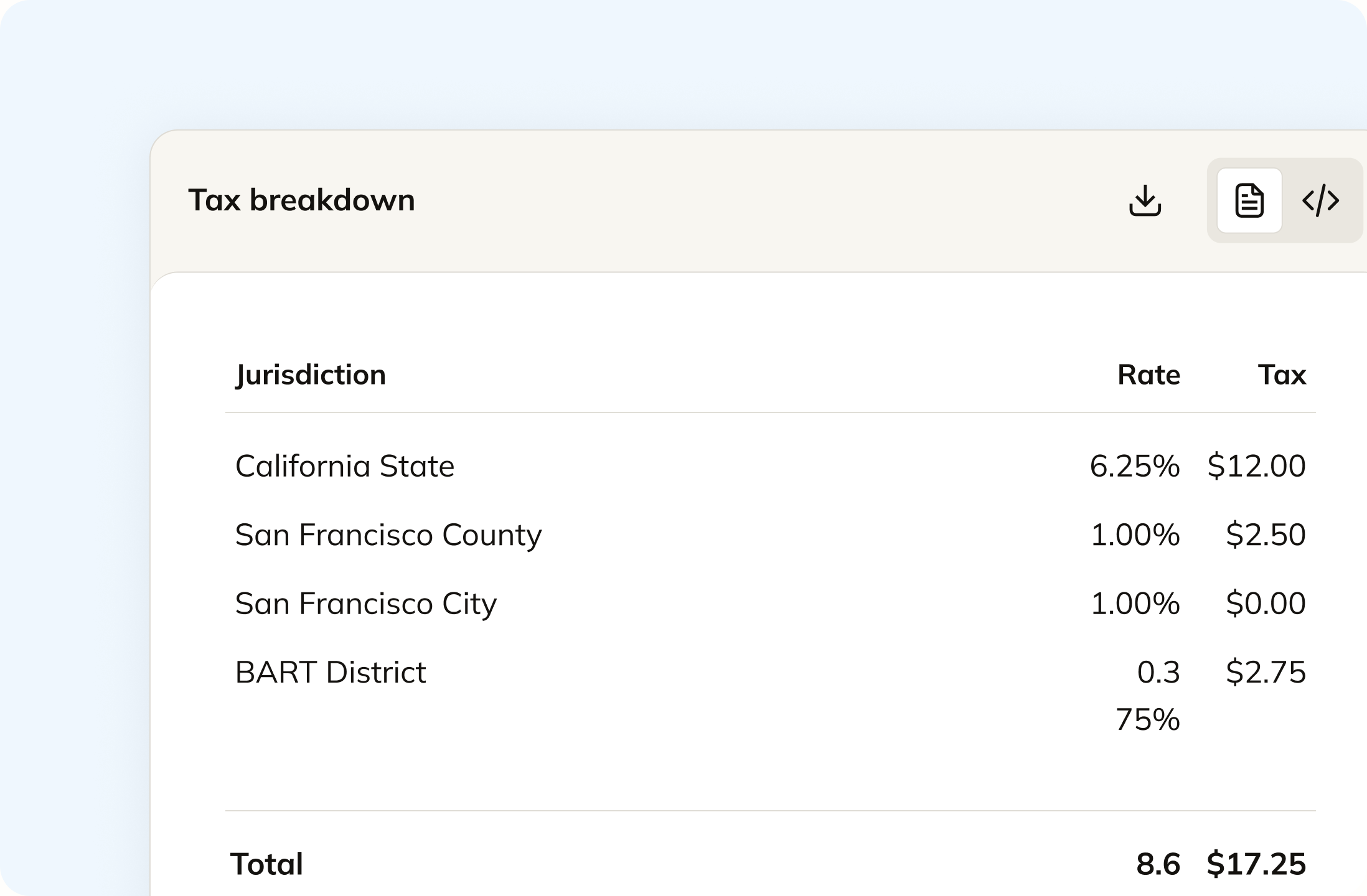
Rillet is clear about the split. Native VAT and GST cover its international markets, and domestic sales tax runs through an integration. That integration is the decision this page is about. Commenda maintains the rate per US jurisdiction, applies it per transaction, and keeps the source of every figure, so one platform covers the states and the countries.
Track your global exposure from Rillet
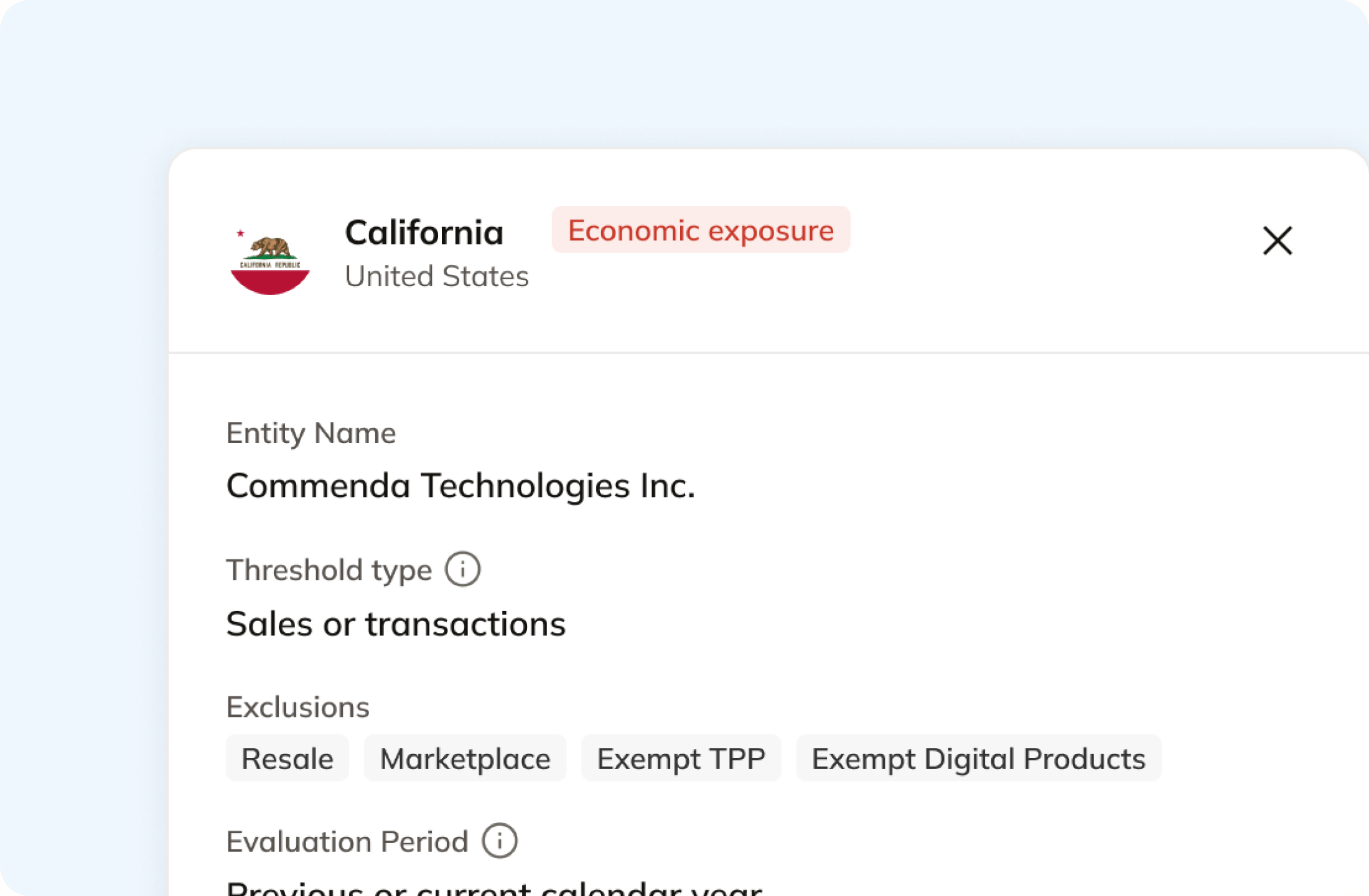
A general ledger records the invoice. It does not count that invoice toward a state threshold you have not crossed yet. Commenda measures the same revenue against economic thresholds in all 50 states and 70+ countries and tells you at 80%, before you cross. A short questionnaire covers physical presence too, because an office or a remote employee never shows up on an invoice.
Register and file in every country you sell into
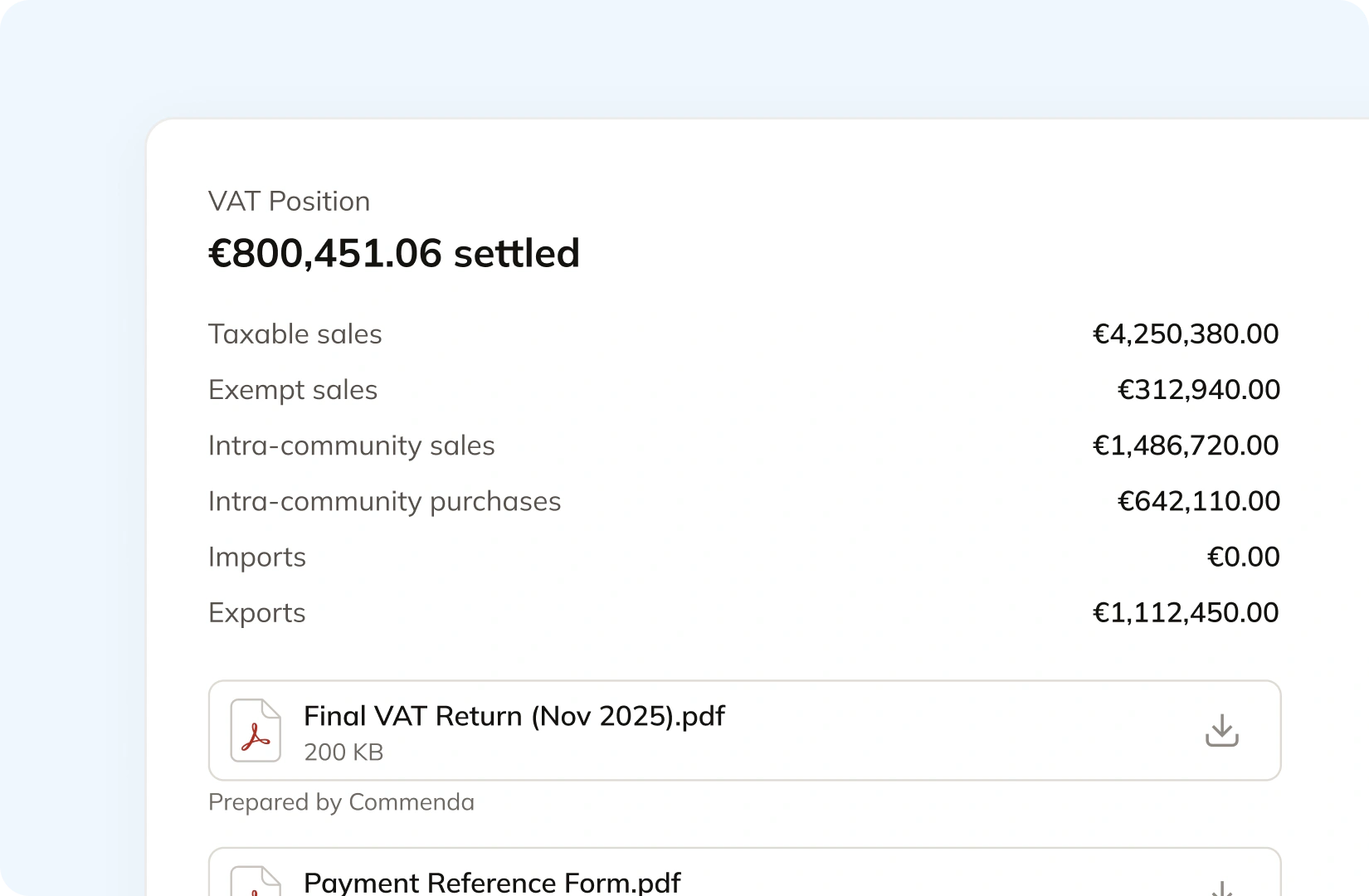
Rillet's end-to-end filing is the UK Making Tax Digital VAT return. Australia, Canada and the other countries it carries produce a report that someone still has to file. Commenda registers you in all 50 states, across EU VAT including OSS and IOSS, and for GST in APAC and Canada, then builds the return and files it on each jurisdiction's required frequency.
Manage your customers and exemptions in one place
Rillet names evidence management, and gives exemption certificates as its example, among the reasons to bring a third-party engine. Commenda holds a verified tax ID on the customer record with the system it came from. Certificates work the same way. Your customers upload through a portal, each one is validated on upload, and it applies automatically where it is valid.

Consolidation
Where Rillet stops, in its own words
Rillet built the indirect tax a fast close needs, and drew the line there deliberately. Past that line sit the parts that make tax hard: where you owe, where you are registered, what your product is taxable as, and who files. Commenda covers those on top of your Rillet data.
Rillet publishes its own list of when you need a tax engine
Rillet's Canadian tax page says you may still prefer, or be required, to use a specialized third-party tax engine if you need place-of-supply determinations, product taxability rules, real-time rate updates across many jurisdictions, cross-border calculation, or evidence management such as exemption certificates. That is most of what indirect tax is.
Native VAT covers a fixed list of countries
Rillet calculates UK VAT, Australian GST and Canadian GST, HST and PST natively, and reports for a handful more, which is more than most ledgers offer. It is still a list. The next country you sell into is either on it or it is not. Commenda covers 70+ countries and adds a jurisdiction before you need it.
A tax partner only sees Rillet invoices
Rillet's tax integrations calculate on the invoices that pass through Rillet. Revenue from a marketplace, a reseller, an app store or a second billing system counts toward the same state threshold and none of it appears. Physical presence never appears on an invoice at all. One office or one remote employee creates an obligation with no revenue threshold to cross first.
One number per state, whatever it came through
Rillet is one of 100+ systems Commenda reads, and each transaction keeps its origin, its product tax code, and any tax already collected. An app store sale that was never yours to tax stays separate from a direct invoice that needs it. You get one exposure figure per state and one return per period.
What it requires
What Rillet hands to someone else
Rillet is unusually direct about its own boundary, which makes this table short work. Five of the rows below are Rillet naming the handover itself, on a help page written for its Canadian customers. Two worth reading twice: US sales tax is an integration by Rillet's own statement, and the one return it files end to end is the UK's.
| What you need | What Rillet requires | Source |
|---|---|---|
| US sales tax calculated on an invoice | An integration. Rillet states that native VAT and GST cover international markets and that domestic sales tax runs through integrations, naming Avalara and Anrok as the recommended ones | Rillet, global expansion |
| Place of supply decided for you | A third-party engine. Rillet lists automated place-of-supply determinations first among the reasons you may still prefer, or be required, to use one | Rillet, Canadian tax support |
| Product and service taxability rules | A third-party engine. Rillet names taxability rules in the same list, and its partner setups ask you to map each product to the partner's own tax codes | Rillet, Canadian tax support |
| Exemption certificates kept and applied | A third-party engine. Rillet lists evidence management as a reason to bring one, and gives exemption certificates as its example | Rillet, Canadian tax support |
| Cross-border and multi-country calculation | A third-party engine. Rillet names it alongside high-volume, real-time rate updates across many jurisdictions | Rillet, Canadian tax support |
| To know when you crossed a state threshold | The tax partner. Nexus appears nowhere in Rillet's published API, and every mention on its site is a capability it attributes to Taxwire, Kintsugi, Zamp or Anrok | Rillet integrations |
| A registration in a new state | The tax partner. Registrations belong to Zamp, Kintsugi, Numeral and Taxwire in Rillet's own descriptions of each integration | Rillet integrations |
| A VAT return filed outside the United Kingdom | You, from a report. Rillet's end-to-end filing is UK HMRC Making Tax Digital VAT, added in August 2026. Australia, Canada, South Africa, Switzerland, Lithuania and India are reporting | Rillet, August 2026 update |
| A price you can compare before talking to anyone | A demo conversation. Rillet's pricing URL redirects to a demo request, and it says pricing is based on the features you use and your complexity rather than per seat | Rillet help center |
US sales tax calculated on an invoice
An integration. Rillet states that native VAT and GST cover international markets and that domestic sales tax runs through integrations, naming Avalara and Anrok as the recommended ones
Rillet, global expansionPlace of supply decided for you
A third-party engine. Rillet lists automated place-of-supply determinations first among the reasons you may still prefer, or be required, to use one
Rillet, Canadian tax supportProduct and service taxability rules
A third-party engine. Rillet names taxability rules in the same list, and its partner setups ask you to map each product to the partner's own tax codes
Rillet, Canadian tax supportExemption certificates kept and applied
A third-party engine. Rillet lists evidence management as a reason to bring one, and gives exemption certificates as its example
Rillet, Canadian tax supportCross-border and multi-country calculation
A third-party engine. Rillet names it alongside high-volume, real-time rate updates across many jurisdictions
Rillet, Canadian tax supportTo know when you crossed a state threshold
The tax partner. Nexus appears nowhere in Rillet's published API, and every mention on its site is a capability it attributes to Taxwire, Kintsugi, Zamp or Anrok
Rillet integrationsA registration in a new state
The tax partner. Registrations belong to Zamp, Kintsugi, Numeral and Taxwire in Rillet's own descriptions of each integration
Rillet integrationsA VAT return filed outside the United Kingdom
You, from a report. Rillet's end-to-end filing is UK HMRC Making Tax Digital VAT, added in August 2026. Australia, Canada, South Africa, Switzerland, Lithuania and India are reporting
Rillet, August 2026 updateA price you can compare before talking to anyone
A demo conversation. Rillet's pricing URL redirects to a demo request, and it says pricing is based on the features you use and your complexity rather than per seat
Rillet help center
Figures verified on September 16, 2026.
From the field
Trusted by businesses across the globe


“The platform works exactly the way I need it to. I have one team member who manages all of our exemption certificates, and that functionality has been particularly efficient for us. It allows him to handle everything seamlessly, making the handoff significantly easier.”
VP of Finance, TRX






Compare Commenda sales tax software with competitors
Rillet groups eight sales tax vendors into one integration category and expects you to choose. If that is the decision in front of you, we compare the alternatives on coverage, ratings, and real pricing, and we say where each one wins.
More sales tax resources
Guides from the Commenda team on VAT, nexus, state filing, and SaaS taxability.
Frequently asked questions
Both, depending on the country. Rillet calculates VAT and GST natively where it has built the rates, covering UK VAT including the reverse charge, Australian GST with its BAS variants, and Canadian GST, HST and PST at line level. US sales tax is different, and Rillet says so plainly: native VAT and GST cover international markets, and domestic sales tax runs through integrations. Its own recommendation for the US is a third-party engine. So the question is not whether you need something alongside Rillet, it is what that something covers. Commenda covers US sales tax, EU VAT and GST across 70+ countries from one platform.
Because that is the only return it files. Rillet added end-to-end HMRC Making Tax Digital VAT in August 2026, with one-click or automatic approval and no extra fee, and it is a genuine filing capability. Everywhere else, including Australia and Canada where the calculation is native, you get a report and someone on your team still files it. Commenda files across all 50 US states and 70+ countries on each jurisdiction's own frequency, with amendments where a period needs correcting. If the United Kingdom is the only place you file, Rillet has you covered.
The number of vendors, and what the exposure figure is measured on. A tax engine connected to Rillet calculates on the invoices that pass through Rillet, and files on its own subscription. Commenda reads your Rillet ledger and every other channel you sell through, across 100+ integrations, into one ledger tagged by ship-to state, then registers and files from that. Teams usually move because they were holding a ledger, an engine, and a filing relationship, and wanted one accountable vendor instead of three.
No. Nexus appears nowhere in Rillet's published API, and every mention of threshold monitoring on its site is a capability it attributes to a tax partner. That gap matters because sales tax liability starts on the day you cross a threshold, not on the day you notice. Commenda notifies you at 80% of a registration threshold so the registration can go in while you are still under it, and a questionnaire covers physical presence as well, since an office or one remote employee creates an obligation with no revenue threshold to cross first.
Not as filings. Ireland and Austria appear in Rillet's changelog as VAT rates applied on invoices, and Lithuania and Switzerland appear as reporting, which is useful for closing the books. No EU member-state VAT return, One Stop Shop, Import One Stop Shop, or e-invoicing mandate support is published anywhere on its site. The fourteen European countries Rillet names are bank feeds, not VAT registrations. Commenda registers and files VAT across the EU including OSS and IOSS, which is what distance selling into the bloc actually requires.
Not Rillet. It names evidence management, giving exemption certificates as its example, among the reasons to use a specialized third-party tax engine, so certificates live in whichever partner you chose. Commenda collects them through a portal your customers upload to, validates each one on upload, stores it against the customer record, and applies it automatically on future transactions where it is valid. During an audit the certificate is already on file, which is the point at which the difference is felt.
Your invoices and credit memos, the ledger behind them, and the entity each one belongs to. That one connection feeds three things: sales tax and VAT calculation, your monthly close, and the intercompany testing behind transfer pricing. You choose which entities and which data models sync, and what Commenda can read and write, and those scopes stay visible and editable after setup. Access runs per user and per entity, so auditors get read-only access without shared credentials.
Custom integration support for your business
Rillet setups differ in where the revenue comes from. Some teams bill through Stripe, some through Chargebee, some raise invoices from Salesforce. We map how yours works, including which entities use Rillet's native VAT and which revenue arrived already taxed, and build the integration to match.
Indirect Tax
Monitor nexus exposure, register, file, and remit sales tax and VAT in one platform. Commenda keeps you compliant across 100+ jurisdictions.
Explore the product
