An invalid or inactive CUIT means rejected invoices, denied input VAT (Value-Added Tax) credits, and audit exposure. Verifying one is free, online, and takes minutes. You run the check through the Constancia de Inscripción tool published by ARCA, Argentina’s tax and customs authority.
Argentina’s federal tax authority AFIP (Administración Federal de Ingresos Públicos) became ARCA (Agencia de Recaudación y Control Aduanero) in 2024. If you searched “AFIP CUIT verification,” you are in the right place. The tool and the process still exist under ARCA.
What Is a CUIT Number in Argentina?
The CUIT (Clave Única de Identificación Tributaria) is Argentina’s 11-digit tax registration number for entities and self-employed individuals, and it functions as the VAT ID. ARCA, formerly AFIP, issues and manages it. Businesses, freelancers, and foreign companies with a registered presence in Argentina all need one.
A CUIT shows up at every tax touchpoint:
- Paper invoices (facturas) and electronic invoices
- Business registration documents
- Customs clearance paperwork
- Every filing submitted to ARCA
Verifying a CUIT before a transaction confirms the identifier is valid and active before money moves.
Did AFIP Become ARCA? What Changed for CUIT Verification?
Yes. Decreto 953/2024 dissolved AFIP and created ARCA as its legal successor, published in the Boletín Oficial (Official Gazette) on October 25, 2024, per the official decree. ARCA keeps AFIP’s two arms: the DGI (Dirección General Impositiva) for domestic taxes and the DGA (Dirección General de Aduanas) for customs. The Constancia de Inscripción lookup carried over unchanged.
| Element | Under AFIP | Under ARCA | Source |
|---|---|---|---|
| Authority name | AFIP | ARCA | Decreto 953/2024, Boletín Oficial, Oct 25 2024 |
| Signed / effective | — | Signed Oct 24 2024, effective same day | Decreto 953/2024 text, Art. 12 |
| Domestic taxes | DGI | DGI (retained) | Decreto 953/2024, Art. 4 |
| Customs | DGA | DGA (retained) | Decreto 953/2024, Art. 4 |
| Verification tool | Constancia de Inscripción | Constancia de Inscripción (unchanged) | ARCA Constancia tool |
ARCA inherited all of AFIP’s powers, including CUIT administration, as legal successor (continuadora jurídica) under Articles 6-7 of the decree. In practice the legacy afip.gob.ar domain now serves ARCA-branded content, so the verification tool still lives on the same address.
What Is the CUIT Number Format?
A CUIT is 11 digits in NN-NNNNNNNN-N form: a two-digit type prefix, an eight-digit body (usually derived from the DNI for individuals), and one check digit. The prefix tells you whether the holder is an individual or a legal entity. For example, 30-12345678-1 is a company CUIT.
| Prefix | Assigned to | Source |
|---|---|---|
| 20, 23, 24, 27 | Individuals (persona física); assigned randomly and gender-neutral | Resolución Conjunta 5007/2021 (AFIP-ANSES), published Jun 10 2021 |
| 30, 33, 34 | Legal entities (persona jurídica) | AFIP RG 4991/2021, published May 17 2021 |
Common CUIT entry errors: missing digits, typos, an outdated identifier, or the wrong prefix. Any one of them returns an invalid result.
How Do You Validate a CUIT Checksum?
Multiply the first 10 digits by the fixed weights 5, 4, 3, 2, 7, 6, 5, 4, 3, 2, sum the products, take the result modulo 11, and subtract from 11 to get the check digit. This is Argentina’s published modulo-11 CUIT specification. It lets developers and spreadsheet users catch typos offline before hitting the portal.
| Step | Action |
|---|---|
| 1 | Line up the first 10 digits, left to right |
| 2 | Multiply them by weights 5, 4, 3, 2, 7, 6, 5, 4, 3, 2 |
| 3 | Sum the 10 products |
| 4 | Compute sum mod 11 |
| 5 | Check digit = 11 − (sum mod 11) |
Edge cases from the same specification: if the remainder is 0, the check digit is 0; if the remainder is 1, a special substitution applies (the prefix commonly shifts to 23 for an individual). A passing checksum confirms format only, not that the CUIT is live, so always follow it with a portal lookup.
How Do You Verify a CUIT on the ARCA Portal?
Use ARCA’s Constancia de Inscripción tool, enter the 11-digit CUIT, complete the security check, and submit (“Consultar”). This is the legally recognized official verification path, it is free, and it needs no login.
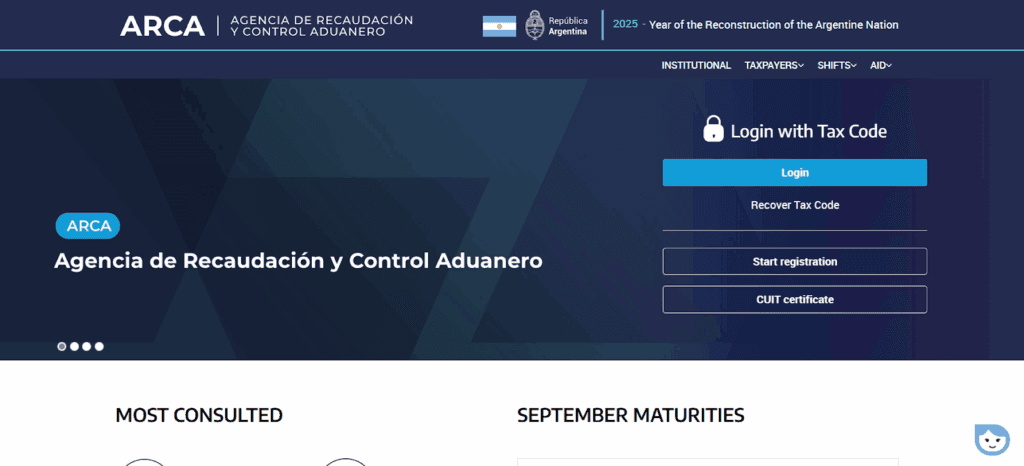
The Constancia returns the registered name, registration status, person type, fiscal address, registered activity codes, and tax regimes (IVA / VAT, Ganancias / income tax, and Monotributo). ARCA’s own web service manual (WS_SR_constancia_inscripcion, Versión 3.7, July 2025) lists these fields, including `estadoClave` for status and `datosMonotributo` for the simplified regime.
How Do You Check If a CUIT Is Active or Inactive?
The Constancia result shows the status directly in the `estadoClave` field. Active means the taxpayer is authorized for VAT operations. Inactive can signal closure, deregistration, or lapsed activity. Suspended or blocked is a red flag before onboarding a supplier.
| Status | What it means | Action |
|---|---|---|
| Active (ACTIVO) | Registered and authorized for VAT operations | Safe to invoice; keep the Constancia on file |
| Inactive | Closure, deregistration, or lapsed activity | Request updated records before transacting |
| Suspended / blocked | Flagged by ARCA | Do not onboard until resolved |
Source: ARCA WS constancia manual, Versión 3.7 (2025).
What Is the Base de Contribuyentes No Confiables?
It is ARCA’s public registry of taxpayers flagged for apocryphal invoices (facturas apócrifas) and fraudulent operations. Checking it is a separate step from the active/inactive lookup, because a CUIT can be active yet still listed. Screening this registry protects your input credits.
Check the registry at three moments: onboarding a new supplier, running periodic vendor due diligence, and before claiming input credits on large invoices. A hit means the counterparty’s invoices may be rejected as apocryphal, taking your VAT credit with them.
What Is the Difference Between CUIT, CUIL, CDI, and DNI?
CUIT identifies taxpayers with economic activity, CUIL identifies employees for labor and social security, CDI covers people who need a tax ID without taxable activity, and DNI is the national identity number the CUIT/CUIL body is usually derived from. Readers routinely confuse them.
| Identifier | Who gets it | Purpose | Source |
|---|---|---|---|
| CUIT | Taxpayers with economic activity | Tax registration / VAT ID | ARCA |
| CUIL | Employees and workers | Labor and social security | ANSES |
| CDI | People needing an ID without taxable activity | Identification only | ARCA |
| DNI | All individuals | National identity; CUIT/CUIL body derives from it | RENAPER |
Does an Active CUIT Mean the Supplier Is VAT-Registered? (Monotributo)
No. Monotributistas hold a valid, active CUIT but are not registered for standard IVA (Impuesto al Valor Agregado). They pay a single consolidated simplified tax and issue Factura C, so the buyer generally cannot claim input VAT credit from them.
The Constancia shows whether a taxpayer is a Responsable Inscripto (full VAT registrant) or a Monotributista in its regime fields. That distinction, not the active status alone, is what actually protects your VAT claim. Confirm the regime before you assume a supplier’s invoice carries recoverable VAT.
Which Invoice Type Can a Verified CUIT Issue?
The counterparty’s registration status determines the factura letter, and the letter determines whether you can claim input credit. A Responsable Inscripto can issue Factura A with itemized VAT; a Monotributista cannot.
| Invoice | Issued by / to | VAT treatment | Input credit | Source |
|---|---|---|---|---|
| Factura A | Between Responsables Inscriptos | VAT itemized separately | Claimable | ARCA facturación regime |
| Factura B | To final consumers or exempt parties | VAT included, not discriminated | Not claimable | ARCA facturación regime |
| Factura C | Monotributistas / exempt sellers | No VAT discriminated | Not claimable | ARCA facturación regime |
| Factura E | Exports | Export treatment | N/A | ARCA facturación regime |
A wrong or inactive CUIT can cause a rejected electronic invoice, because ARCA validates the issuer’s CUIT when authorizing each e-invoice. Verifying the counterparty first is what tells you which letter they can legally issue.
What Happens If You Skip CUIT Verification?
Skipping verification risks denied input credits, audit exposure, association with blocked or fraudulent counterparties, and rejected electronic invoices caused by CUIT errors. On the positive side, a valid CUIT is mandatory for filings and invoicing, it is the basis for reclaiming VAT input credits, and verified CUITs build trust between suppliers and customers.
Argentina’s tax procedure law (Ley de Procedimiento Tributario, Ley 11.683) and the Régimen Penal Tributario govern penalties for omission and fraud, which can include fines, denied deductions, and criminal exposure above set thresholds. Peso thresholds change often with inflation, so confirm current figures with a primary source before relying on any number. The mechanism matters more than any stale amount: unsupported or fraudulent invoices lose their credit and invite audit.
Why Does a CUIT Lookup Return Invalid or No Records?
Three causes account for most failed lookups: a CUIT that is unassigned or too new, an inactive or suspended taxpayer, and a formatting error. The portal message usually tells you which one you hit.
| Message | Likely cause | Fix |
|---|---|---|
| CUIT no registrado | Not yet assigned or too new | Allow a few business days after registration; confirm with ARCA |
| CUIT inactivo | Suspended, deregistered, or closed | Contact the taxpayer and request updated records |
| Formato inválido | Wrong digit count or format | Enter 11 digits as NN-NNNNNNNN-N |
Source: ARCA Constancia de Inscripción tool.
How Can You Automate Bulk CUIT Verification?
Manual portal lookups do not scale past a handful of vendors. They are one-at-a-time, gated by a security check, and give no audit trail or monitoring once a supplier is onboarded. Finance teams instead run batch (CSV) checks and API validation to verify suppliers continuously.
The practical decision is manual for one-off checks, bulk CSV for a vendor list, and API for continuous monitoring, since a CUIT valid at onboarding can later be suspended. Commenda’s indirect tax platform handles ongoing supplier verification and VAT compliance, and Commenda’s Global Tax ID Verification tool checks tax IDs across countries. It connects through 100+ ERP, API, and custom integrations, so verification lives inside your systems rather than a spreadsheet.
How Commenda Helps With Argentina VAT ID Verification
Commenda’s global indirect tax software handles VAT registration, filing, and ongoing compliance across jurisdictions, so supplier verification and Argentina’s VAT obligations stop living in spreadsheets. It connects through 100+ ERP, API, and custom integrations to verify CUITs where your vendor data already lives.
Expanding across the region? Commenda covers the same ground for Brazil CNPJ verification, Mexico RFC verification, Colombia VAT verification, and Chile VAT verification, plus the broader Argentina corporate tax guide for how CUIT accuracy feeds your filings.
Book a demo to see how Commenda automates supplier tax ID verification and VAT compliance in Argentina and across LATAM: book a demo call.