Paying a supplier against an invalid NIT costs you IVA credits and invites sanctions from la DIAN. Colombia’s tax authority rejects input-tax credits tied to registrations that were never valid, and vendor fraud lands on the buyer.
You can prevent that. Anyone can verify a Colombian NIT free, in real time, on the portal of the Dirección de Impuestos y Aduanas Nacionales (DIAN), Colombia’s tax and customs authority. The NIT (Número de Identificación Tributaria) is the tax number DIAN issues to every registered taxpayer, and its status is public. Start with DIAN’s official RUT guidance.
What Is Colombia’s VAT ID? The NIT Explained
The NIT is Colombia’s tax identification number and functions as the country’s VAT ID equivalent. Colombia’s value-added tax is IVA (Impuesto sobre las Ventas), charged at a general rate of 19% under Article 468 of the Estatuto Tributario. There is no separate VAT number as in the EU; the NIT serves that role.
The NIT is required for filing returns, issuing invoices and e-invoices, clearing customs, and reclaiming IVA credits. Local businesses, foreign companies operating in Colombia, and individuals with Colombian tax obligations all need one. By law it must appear on invoices, electronic invoices, customs documents, and tax returns. DIAN defines the NIT as the unique number that “permite la individualización inequívoca de los inscritos” in tax, customs, and exchange matters, per its official RUT and NIT page.
What Is the Difference Between the NIT and the RUT in Colombia?
The RUT (Registro Único Tributario) is the registration record administered by DIAN; the NIT is the unique number issued within it. You cannot hold a NIT without RUT registration. Individuals not required to register in the RUT are identified by their cédula de ciudadanía instead. The two terms are related but not interchangeable.
DIAN defines the RUT as “el mecanismo único para identificar, ubicar y clasificar a los sujetos de obligaciones administradas por la DIAN,” per its RUT FAQ. The NIT rests on Article 555-1 of the Estatuto Tributario, and the RUT registry on Article 555-2, according to that same DIAN page. Registration is free, carries indefinite validity, and never requires renewal, though data changes must be updated.
What Is the NIT Number Format in Colombia?
A company NIT is 9 digits plus a check digit, written NNNNNNNNN-D. Company NITs typically begin with an 8xx or 9xx series (800, 830, 860, 900, or 901). An individual’s NIT is their cédula number plus a check digit. Decreto 2460 de 2013, Art. 4, sets that a legal entity’s identification is its business name plus the NIT “adicionado con un dígito de verificación.”
| Taxpayer type | Structure | Example | Source |
|---|---|---|---|
| Company / legal entity | 9 digits + check digit (NNNNNNNNN-D), 800/830/860/900/901 prefixes | 900123456-8 | Decreto 2460 de 2013, Art. 4 (DIAN normograma) |
| Individual / natural person | Cédula number + check digit | 79123456-3 | Decreto 2460 de 2013 (DIAN normograma) |
Common entry errors are simple: omitting the dash, dropping the final check digit, or transposing digits. Any of these produces an error in DIAN’s system.
How Does NIT Check Digit Validation Work?
DIAN computes the dígito de verificación (DV) with a modulo-11 algorithm. Each NIT digit, read right to left, is multiplied by a fixed prime-weight series: 3, 7, 13, 17, 19, 23, 29, 37, 41, 43, 47, 53, 59, 67, 71. The products are summed and divided by 11. If the remainder is 0 or 1, that is the DV; otherwise the DV equals 11 minus the remainder. DIAN’s Orden Administrativa 4 de 1989 sets this method.
Worked example for base NIT 900123456:
| Digit | Weight | Product |
|---|---|---|
| 9 | 41 | 369 |
| 0 | 37 | 0 |
| 0 | 29 | 0 |
| 1 | 23 | 23 |
| 2 | 19 | 38 |
| 3 | 17 | 51 |
| 4 | 13 | 52 |
| 5 | 7 | 35 |
| 6 | 3 | 18 |
| Sum | 586 |
586 divided by 11 leaves a remainder of 3. Since the remainder exceeds 1, the DV is 11 minus 3, which equals 8. The complete NIT is 900123456-8. Per Concepto DIAN 78424 de 2002, the DV “no se considera como número integrante del NIT”; it exists only to authenticate correct issuance.
How Do You Verify a VAT ID in Colombia on the DIAN Portal?
The DIAN RUT consultation (“Consulta del Estado del RUT”) is free, public, and real time, running on DIAN’s transactional system MUISCA. No login is required for a basic check. The service returns registration status directly from the authoritative source, per DIAN’s RUT consultation page.
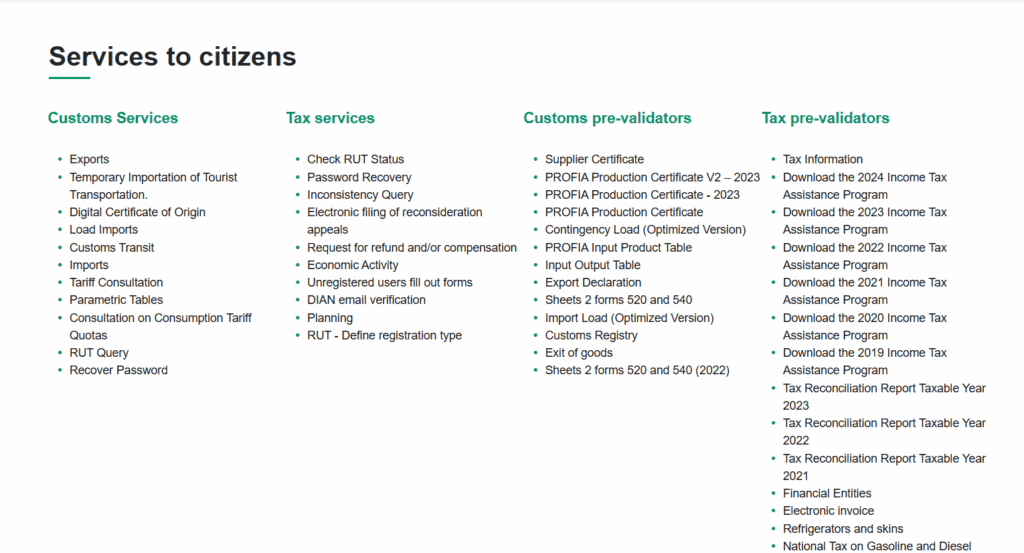
Follow these steps:
- Open the MUISCA RUT status consultation. DIAN migrates tools between MUISCA, GOV.CO, and SUIT, so navigate from dian.gov.co if the deep link moves.
- Enter the full NIT, including the check digit. The system accepts it with or without the hyphen.
- Complete the CAPTCHA (Completely Automated Public Turing test) security step exactly as shown.
- Submit the search to run a live check against DIAN’s database.
Troubleshooting note: the DIAN page requires JavaScript and warns when it is disabled. Enable JavaScript before loading the consultation.
What Does a DIAN NIT Lookup Show, and How Do You Read the Results?
The lookup confirms whether the NIT is registered and returns the estado del RUT (Activo, Inactivo, or Suspendido), the registrant’s name (razón social), the economic activity, and the tax responsibilities, per the MUISCA consultation service. An Activo status means the taxpayer can issue valid invoices. Inactivo or Suspendido means do not use that NIT for IVA credits. No record usually signals a typo, a brand-new NIT, or an invalid number.
Common results and how to resolve them:
| Result / message | Likely cause | Quick fix |
|---|---|---|
| “NIT no registrado” | Newly issued NIT not yet reflected | Retry later; confirm the number with the supplier |
| “Estado: Inactivo” | Entity dissolved, suspended, or closed | Contact the supplier or DIAN before transacting |
| “Formato incorrecto” | Missing check digit or malformed entry | Re-enter the full NIT with the correct DV |
| “Información no disponible” | Temporary DIAN syncing or downtime | Retry later |
Why Should Businesses Verify Colombian NITs Before Paying Suppliers?
Unverified NITs cost real money. DIAN rejects IVA credits tied to invalid registrations, and vendor fraud becomes the buyer’s problem during an audit. The Estatuto Tributario sets specific, UVT-denominated sanctions for RUT and invoicing failures. For 2026, DIAN fixed the UVT (Unidad de Valor Tributario) at COP $52,374 via Resolución 000238 of December 15, 2025, so a 100-UVT fine equals COP $5,237,400.
| Violation | Sanction | Source |
|---|---|---|
| Late RUT registration (with establishment) | Closure of 1 day per month of delay | Art. 658-3, num. 1 (Ley 1111 de 2006) |
| Late RUT registration (no establishment) | 1 UVT/day of delay (COP $52,374/day) | Art. 658-3, num. 1 |
| Late RUT update (general) | 1 UVT/day of delay | Art. 658-3, num. 3 |
| Late RUT update (address or economic activity) | 2 UVT/day of delay (COP $104,748/day) | Art. 658-3, num. 3 |
| False, incomplete, or erroneous RUT data | 100 UVT (COP $5,237,400) | Art. 658-3, num. 4 |
| Invoicing violation (no invoice or missing required elements) | 3-day establishment closure | Art. 657 (mod. Ley 1819 de 2016) |
These figures are confirmed against the official Estatuto Tributario text published by Colombia’s Senate and Función Pública’s compilation of Article 658-3.
How Do Foreign Companies Get and Verify a NIT in Colombia?
Foreign companies with Colombian tax obligations register in the RUT and receive a NIT, verifiable through the same free public lookup. This includes non-resident digital service providers that register for IVA under Colombia’s simplified regime. Registration runs through DIAN’s MUISCA platform or its puntos de atención, and foreign registrants often use professional help because document requirements are heavier than for local entities.
Once registered, a foreign company’s NIT behaves like any other in the consultation tool: enter the number with its check digit and read the estado del RUT. If you are still setting up, see Commenda’s guide to VAT registration in Colombia for foreign companies.
How Can Finance Teams Automate NIT Verification at Scale?
DIAN offers no bulk upload and no public API. One-at-a-time, CAPTCHA-gated lookups do not scale past a handful of vendors. Manual checks work for a short onboarding list; automation pays off once you onboard many vendors or run quarterly re-checks across a supplier base.
Commenda verifies tax IDs in real time against official sources, so finance teams can validate a NIT at onboarding and re-check on a schedule without hand-keying each number. Commenda supports 100+ ERPs, APIs, and custom integrations, so verification fits into existing AP and procurement workflows; see Commenda’s integrations. For multi-country vendor bases, the same layer covers other Latin American tax IDs that use check-digit systems, from Mexico’s RFC to Brazil’s CNPJ.
How Commenda Helps With Colombian NIT Verification
Verify every NIT before the first invoice, and automate once your vendor count grows. That single discipline protects your IVA credits and keeps you clear of the Estatuto Tributario sanctions above.
Commenda’s indirect tax platform gives you real-time tax ID verification and IVA compliance tracking across jurisdictions, so a controller sees what is verified, what is filed, and what is due in one place. Pair it with Commenda’s global tax ID verification tool to validate suppliers across countries from one workflow. Book a demo to see a live NIT check run against your own vendor list.