An invalid Czech VAT number on a B2B invoice costs you the input VAT (value added tax) deduction and can trigger penalties of up to CZK 300,000 under the Czech Tax Code (Act No. 280/2009 Coll.). The Financial Administration of the Czech Republic (Finanční správa České republiky) denies the deduction at audit, so verifying the number before you pay protects both the deduction and your audit trail.
This guide shows you how to run VAT ID verification for a Czech VAT number on the European Commission’s VIES (VAT Information Exchange System) tool and the Financial Administration registers. It covers the format rules, the checksum, and the 2025 registration changes that still govern 2026.
What Is a Czech VAT Number (DIČ)?
A Czech VAT number is the DIČ (Daňové identifikační číslo, tax identification number), formatted as CZ plus 8, 9, or 10 digits and issued by the Financial Administration once an entity registers for DPH (Daň z přidané hodnoty, value added tax). For a legal entity, the DIČ root equals the company’s IČO, so its VAT number is CZ plus its IČO.
IČO (Identifikační číslo osoby) is the 8-digit company registration number every Czech entity holds regardless of VAT status. For natural persons, the root is the rodné číslo, the birth number that forms the 9- or 10-digit root instead of an IČO.
What Is the Czech VAT Number Format?
A Czech VAT number is CZ plus 8 digits for legal entities, CZ plus 9 digits for natural persons born before 1954, and CZ plus 10 digits for other natural persons. The digit count follows the entity type, not an arbitrary choice: the root is the IČO for companies and the rodné číslo for individuals.
| Entity type | Format | Root source | Example | Source |
|---|---|---|---|---|
| Legal entity | CZ + 8 digits | IČO | CZ12345678 | Financial Administration of the Czech Republic |
| Natural person (born before 1954) | CZ + 9 digits | Older rodné číslo | CZ123456789 | Financial Administration of the Czech Republic |
| Natural person | CZ + 10 digits | Rodné číslo | CZ1234567890 | Financial Administration of the Czech Republic |
How Does Czech VAT Number Validation Work Beyond Format Checks?
A regex length check is not enough, because a legal-entity number carries a modulo-11 checksum on its 8-digit IČO, where the last digit is a check digit. A number can be the right length and still fail the checksum. Validation runs in three layers: a format check, a checksum check, then a registry check on VIES or the Financial Administration to confirm the number is issued and active.
The checksum works like this. Multiply the first seven IČO digits by weights 8, 7, 6, 5, 4, 3, and 2, sum the products, and take the remainder modulo 11. If the remainder is 0 the check digit is 1; if it is 1 the check digit is 0; otherwise the check digit is 11 minus the remainder. Worked example: for the root 4527464, the weighted sum is 156, 156 modulo 11 is 2, and 11 minus 2 gives check digit 9, producing IČO 45274649 and VAT number CZ45274649.
How Do You Verify a Czech VAT Number on VIES Step by Step?
Enter the number with its CZ prefix at the European Commission’s VIES tool, and VIES confirms whether it is valid for intra-EU trade, returning the registered name and address for Czech numbers. Also enter your own VAT number so VIES issues a consultation number, the request identifier that proves due diligence in an audit.
- Open the VIES portal and select CZ (Czechia) as the member state.
- Enter the Czech VAT number in the number field. The CZ prefix is chosen from the dropdown, not typed into the field.
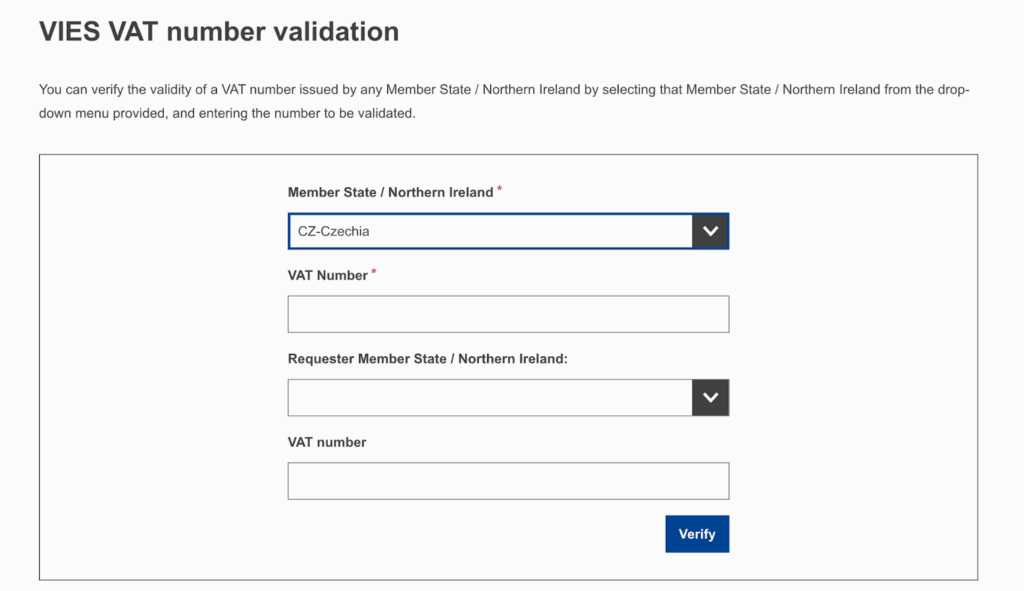
- Enter your own VAT number to generate a consultation number.
- Click Verify and read the result: valid or invalid, plus the name and address if returned.
- Save the result and the consultation number in your compliance file.
VIES shows validity today only. It gives no registration date, and a domestic-only Czech registration may not appear. For those cases, use the Financial Administration register described below.
What If VIES Returns Invalid or No Record?
Most failures come from a typo, the wrong prefix, or a domestic-only registration. Re-check the digit count and prefix first, then confirm status on the Financial Administration register. Retry later if the service is down.
| Result | Likely cause | Fix |
|---|---|---|
| Invalid or not recognized | Typo, wrong digit count, SK instead of CZ, or spaces and hyphens in the number | Re-enter CZ plus 8, 9, or 10 digits with no spaces |
| No record found | Domestic-only registration or not registered | Check the Financial Administration Registr plátců DPH |
| Service unavailable | VIES maintenance or downtime | Retry later or use the Financial Administration register |
Can You Check a Czech VAT Number With the Financial Administration or ARES?
Yes. The Financial Administration publishes the Registr plátců DPH (register of VAT payers), which confirms registration status including domestic-only registrations that VIES may miss. ARES (Administrativní registr ekonomických subjektů), the Ministry of Finance business register, aggregates VAT payer status alongside company data such as the IČO, legal name, and address.
Use VIES for intra-EU counterparties, where cross-border validity is the question. Use the Registr plátců DPH and ARES for domestic counterparties and reliability checks, because those registers show the unreliable-payer flag that VIES does not carry.
What Is an Unreliable VAT Payer (Nespolehlivý Plátce)?
An unreliable VAT payer (nespolehlivý plátce) is a registered payer the Financial Administration has flagged for serious breaches of VAT obligations, published in the Registr plátců DPH. Under the VAT Act (No. 235/2004 Coll., § 109), a customer who pays a flagged supplier can be held jointly liable for that supplier’s unpaid VAT.
The flag persists until the tax office removes it, which the payer can request after one year of compliant behaviour, under § 106a of the VAT Act. Checking the flag before payment is a core due-diligence step, because joint liability attaches even to an otherwise valid transaction.
What Are the Consequences of Using an Invalid Czech VAT Number?
The two direct costs are losing the input VAT deduction and losing zero-rating on intra-EU B2B supplies. At audit the tax office denies the deduction, and the buyer carries the burden of proving the supplier held a valid registration at the time of supply.
A stored VIES consultation number is the accepted due-diligence evidence for that proof. For intra-EU supplies, a valid customer VAT number is a substantive condition for the exemption, so an invalid number means you must charge Czech VAT. The penalties that follow a filing or registration failure are set out in the penalties table below.
What Is the Czech VAT Registration Threshold in 2026?
Since 1 January 2025 the Czech Republic runs a two-tier trigger, still in force for 2026. Exceed CZK 2,000,000 in a calendar year and you become a VAT payer from 1 January of the following year. Exceed CZK 2,536,500 (the EUR 100,000 EU cap) at any point in the year and you become a payer the very next day.
| Threshold | Trigger event | Payer effective date | Source |
|---|---|---|---|
| CZK 2,000,000 | Exceeded in a calendar year | 1 January of the following year | Financial Administration (2025 changes) |
| CZK 2,536,500 (= EUR 100,000) | Exceeded at any point in the year | The day after the threshold is exceeded | Financial Administration / portal.gov.cz |
| EUR 100,000 | EU-wide annual turnover cap for cross-border SME exemption | Applies from 1 Jan 2025 | Council Directive (EU) 2020/285, Art. 284(2)(a) |
| EUR 85,000 | Maximum national exemption threshold a member state may set | Applies from 1 Jan 2025 | Council Directive (EU) 2020/285, Art. 284(1) |
The old rule measured CZK 2,000,000 over any rolling 12 consecutive months. The 2025 amendment (Act No. 461/2024 Coll.) measures it per calendar year, so the counter resets each 1 January and a business that crosses only the lower threshold gets a delayed payer start date it can plan around, per the Financial Administration’s 2025 VAT changes. The same reform launched a cross-border EU SME (small enterprise) exemption scheme, letting a small business be exempt in other member states below EUR 100,000 EU-wide turnover, under Council Directive (EU) 2020/285.
How Do You Register for VAT in the Czech Republic?
You register with the Financial Administration by filing the VAT registration application electronically through the Moje daně portal, as e-filing is mandatory for VAT. You must file within 10 working days of crossing a threshold, per the Financial Administration registration guidance, and you become a payer on your trigger’s statutory date.
Mandatory triggers are the two turnover thresholds above. Voluntary registration is open to businesses below the threshold. Non-established businesses making taxable supplies in the Czech Republic register with no threshold, from their first taxable supply. Once processed, the DIČ appears in the Registr plátců DPH, and distance sellers cross into destination-country VAT once EU-wide B2C sales pass EUR 10,000 under EU One-Stop-Shop rules, per portal.gov.cz.
Do Non-EU Businesses Need a Fiscal Representative in the Czech Republic?
No. Czech VAT law does not require non-established businesses, whether EU or non-EU, to appoint a fiscal representative. They register directly with the Financial Administration for Czech VAT. A business may still use a local tax advisor for filings, but that is optional and not a legal mandate under the VAT Act.
What Are the Czech VAT Rates and Filing Rules in 2026?
The Czech Republic applies a 21% standard rate, a single 12% reduced rate, and a 0% rate on books, all effective since 1 January 2024 when the old 15% and 10% reduced rates were consolidated. Monthly is the default filing period for every new registrant.
| Rate | Scope | Effective | Source |
|---|---|---|---|
| 21% standard | Most goods and services | In force | VAT Act No. 235/2004 Coll. |
| 12% reduced | Food, some pharmaceuticals, public transport, accommodation, water, heating | 1 January 2024 | VAT Act No. 235/2004 Coll. |
| 0% | Books | 1 January 2024 | VAT Act No. 235/2004 Coll. |
Quarterly filing requires prior-year turnover below CZK 15,000,000, raised from CZK 10,000,000 on 1 January 2025 under § 99a of the VAT Act, and it cannot be elected in the year of registration or the following year. The payer must also not be an unreliable payer or a VAT group and must notify the tax administrator. Separately, all payers file the kontrolní hlášení (VAT control statement), a transaction-level report submitted monthly for legal entities alongside the return, per Financial Administration guidance, with its own penalty regime below.
What Are the Penalties for Late VAT Filing in the Czech Republic?
Late VAT filings carry a penalty of 0.05% of the assessed tax per day after 5 working days, capped at 5% and a maximum of CZK 300,000 under the Tax Code (Act No. 280/2009 Coll., § 250). Late payment accrues default interest at the Czech National Bank (CNB) repo rate plus 8 percentage points, so the rate moves with the repo rate rather than sitting at a fixed figure.
| Penalty | Amount | Source |
|---|---|---|
| Late VAT return filing | 0.05% of tax per day, capped at 5%, max CZK 300,000 | Tax Code § 250 (Act No. 280/2009 Coll.) |
| Late payment default interest | CNB repo rate + 8 percentage points | Tax Code (Act No. 280/2009 Coll.) |
| Failure to meet a registration or reporting obligation | Up to CZK 500,000 | Tax Code § 247a |
| Control statement filed late, without a prompt | CZK 1,000 | Financial Administration, VAT Act § 101h(1)(a) |
| Control statement filed only after a tax office prompt | CZK 10,000 | Financial Administration, VAT Act § 101h(1)(b) |
| Failure to respond to a correction request | CZK 30,000 | Financial Administration, VAT Act § 101h(1)(c) |
| Failure to file even after a prompt | CZK 50,000 | Financial Administration, VAT Act § 101h(1)(d) |
How Commenda Helps With Czech VAT Compliance
Verifying a Czech VAT number is a repeatable process, not a one-off check, so it belongs in your systems rather than a spreadsheet. Commenda’s global indirect tax software validates VAT numbers in bulk via CSV upload and a real-time API, tracks your registration obligations across the EU, and handles Czech VAT filings and control statements.
When you onboard a counterparty, Commenda’s Global Tax ID Verification tool checks tax IDs across countries, and the Compliance Calendar tracks Czech filing deadlines by entity. The platform connects to 100+ ERP, API, and custom integrations, so validation and filing run against your existing stack. Book a demo to get a free assessment of your EU VAT registration exposure.