An invalid supplier Value Added Tax (VAT) number costs you the input VAT claim. It breaks reverse-charge treatment on intra-community business-to-business (B2B) sales. It exposes you to fraud, penalties, and interest.
The fix is one free tool. The European Commission’s VAT Information Exchange System (VIES) is the authoritative way to verify a Luxembourg VAT number, and you can run a check on the official VIES validation tool in seconds. Luxembourg’s tax authority administers registration; it does not run a separate public single-field lookup. This guide shows the exact steps, and how to automate them across your vendor base.
How Do You Verify a Luxembourg VAT Number Step by Step?
Go to the VIES tool, select Luxembourg (LU), enter the eight digits, add your own VAT number in the requester fields, run the check, and save the consultation number. VIES queries Luxembourg’s national registry in real time, per the European Commission’s VIES guidance. Entering your requester number returns a unique consultation number, the audit-trail proof that you ran due diligence on that date.
- Open the official VIES VAT validation tool.
- Select Luxembourg (LU) from the member state dropdown.
- Enter the 8 digits that follow the LU prefix.
- Enter your own member state and VAT number in the requester fields.
- Complete the CAPTCHA prompt if one appears.
- Run the check and read the valid or invalid result.
- Save the consultation number and the date of the check.
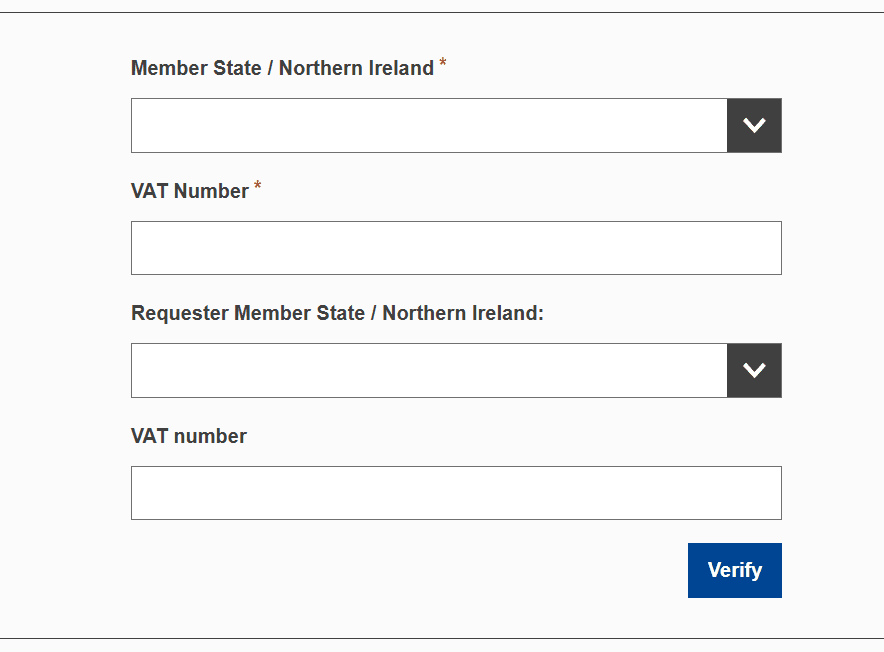
VIES returns a valid or invalid status, and where the member state permits, the trader’s registered name and address. Due to data protection rules, some national authorities only confirm whether a name and address you supply match the number rather than displaying them, per the European Commission. VIES shows current status only, so keep your own consultation-number log for audits.
What Is a Luxembourg EU VAT ID and Who Issues It?
A Luxembourg VAT identification number (format LU plus 8 digits) certifies VAT registration with the Administration de l’Enregistrement, des Domaines et de la TVA (AED), Luxembourg’s Registration Duties, Estates and VAT Authority, per the AED. It is the number used on VIES checks and on intra-community invoices. The AED runs registration, filing, and audits.
Businesses register through MyGuichet.lu, Luxembourg’s government e-services platform, within 15 days of starting a taxable activity, per Luxembourg’s official business guichet. MyGuichet.lu is the registration and filing channel, not a verification tool, so keep it distinct from VIES.
Who needs it: companies supplying goods or services to EU customers, freelancers billing international clients, importers and exporters, and e-commerce sellers reaching EU residents.
Where it appears: cross-border invoices, VAT returns, customs paperwork, and supplier contracts.
Which Luxembourg Tax Number Is Which? VAT ID vs Matricule vs RCS
A Luxembourg business can hold up to three identifiers, and only one works on VIES: the LU VAT number. The national matricule and the trade-register number look official but return invalid on a VIES lookup.
| Identifier | Format | Issued by | Used for | Source |
|---|---|---|---|---|
| VAT identification number | LU + 8 digits | AED | VIES checks, cross-border invoicing | guichet.public.lu |
| National matricule | 11 or 13 digits | Luxembourg State | National administrative ID, not VAT | guichet.public.lu |
| RCS number | B + digits (e.g. B123456) | Registre de Commerce et des Sociétés (RCS) | Trade register entry | RCS Luxembourg |
Do not confuse these. Pasting a matricule or an RCS number into VIES always returns invalid.
What Is the Luxembourg VAT Number Format?
A Luxembourg VAT number is LU followed by exactly 8 digits, for example LU12345678 as a placeholder. The last two digits act as a check number, so the number is internally self-validating rather than arbitrary. Format checks prove a number could exist. Only a VIES lookup proves it does exist and is active. A perfectly formatted number can still be invalid.
| Entry | Verdict | Why | Source |
|---|---|---|---|
| LU12345678 | Correct format | LU prefix plus 8 digits | guichet.public.lu |
| LU1234567 | Invalid | Only 7 digits | guichet.public.lu |
| LX12345678 | Invalid | LX is not a valid country code | European Commission VIES |
| LV12345678 | Wrong country | LV is Latvia, not Luxembourg | European Commission VIES |
| LU 1234 5678 | Rejected | Spaces in the input | European Commission VIES |
Why Does Luxembourg VAT Number Verification Matter?
Verification protects your input VAT deduction, validates the customer for zero-rated intra-community supplies under the reverse charge, supports customs clearance for goods crossing borders, and documents due diligence for audits. Customs and export paperwork routinely require a valid VAT ID, and a verified number prevents clearance delays.
The stakes are large. The European Commission’s 2025 VAT Gap report, published 11 December 2025, put the EU VAT compliance gap at EUR 128 billion, or 9.5% of the VAT Total Tax Liability (VTTL), for 2023, up from EUR 89 billion (7%) in 2022. Verifying counterparty VAT numbers is a frontline defense against the fraud behind that gap.
Luxembourg raises the odds you will need these checks. It is a small economy with an outsized share of cross-border B2B, fund administration, and e-commerce activity, which makes intra-community verification routine, not exceptional.
What Happens If You Use an Invalid VAT Number?
The consequences land on you, not the counterparty. An invalid supplier number voids your input VAT deduction. An unverified customer number breaks the exemption on intra-community supplies, making you liable for the VAT plus penalties and interest. Repeated failures flag you for audit.
Under EU law, when a customer supplies its VAT number the supplier must obtain confirmation of that number’s validity and of the associated name and address. That obligation sits in Article 31 of Council Regulation (EU) No 904/2010, which is why a VIES check counts as due-diligence evidence and why skipping it exposes you at audit.
How Does the Reverse Charge Work for Intra-Community B2B Transactions?
On a cross-border B2B sale within the EU, the seller zero-rates the supply and the buyer self-accounts for VAT in its own country. This works only if the buyer holds a valid VAT number. A valid customer VAT ID, verified at transaction time, is a substantive condition for the exemption under the EU rules, so verification is a legal prerequisite rather than a courtesy check.
This matters for Luxembourg suppliers because so much of their trade is cross-border services and e-commerce. Fail to verify a customer’s number and a zero-rated supply converts into a taxable one that you must fund yourself. The same discipline applies when you trade with neighbors, so verify a German VAT number and run Belgium VAT verification the same way.
What Are Luxembourg’s VAT Rates in 2026?
Luxembourg’s standard VAT rate is 17%, the lowest standard rate in the EU, with 14% intermediate, 8% reduced, and 3% super-reduced rates, per the Portail de la fiscalité indirecte (PFI/AED). These rates have applied since 1 January 2024.
| Rate | Percentage | Applies to | Source |
|---|---|---|---|
| Standard | 17% | Most goods and services (lowest standard rate in the EU) | PFI/AED |
| Intermediate | 14% | Certain wines, advertising, management of some securities | PFI/AED |
| Reduced | 8% | Electricity, gas, cleaning services, hairdressing | PFI/AED |
| Super-reduced | 3% | Food, books, pharmaceuticals, restaurant meals | PFI/AED |
| 2023 temporary cut | 16% / 13% / 7% | Anti-inflation cut, reverted to 17% / 14% / 8% on 1 January 2024 | Loi du 26 octobre 2022; PFI circular |
What Do VIES Results Mean and How Do You Fix Errors?
VIES returns valid (active in Luxembourg’s national registry) or invalid (not found, inactive, deregistered, or malformed). VIES holds no central database and queries each member state live, so “member state service unavailable” means Luxembourg’s system is temporarily down, not that the number is bad. A number can pass format checks and still return invalid, which means it is well-formed but not registered or active.
| Result | Likely cause | Fix |
|---|---|---|
| Invalid VAT number | Wrong digits, wrong prefix, or a matricule entered | Re-check the format, confirm LU plus 8 digits |
| Service unavailable | Luxembourg’s national registry is temporarily down | Retry later; VIES queries each state in real time |
| No match found | Newly issued number not yet propagated | Wait a few business days, then retry |
| Inactive or deregistered | VAT registration cancelled or suspended | Contact the AED to confirm status |
How Do You Build VAT Verification Into Vendor Onboarding?
Verify the VAT number at three moments: when a vendor or customer is onboarded, before the first payment or zero-rated invoice is released; before each major invoice cycle or quarterly filing; and whenever counterparty details change. Gating payment release on a passed check turns verification into a control, not an afterthought.
- Collect the LU number on the onboarding form, not the matricule or RCS number.
- Run format and check-number validation first.
- Run a VIES check with your requester VAT number.
- Store the consultation number and the date.
- Match the returned name and address to your records.
- Block payment release until the check passes.
- Capture the VAT ID as customs documentation for goods traders.
- Re-verify long-term vendors on a set cadence.
A free tool like Commenda’s global tax ID verification helps standardize this step across countries.
How Can You Automate Bulk VAT Number Verification?
Manual VIES lookups do not scale past a handful of vendors. The European Commission publishes a free VIES SOAP web service and a REST application programming interface (API) for programmatic checks, and VAT compliance software layers batch comma-separated values (CSV) validation, consultation-number logging, and scheduled re-verification on top.
The official VIES API confirms VAT-registration status only. It does not confirm solvency or that a specific transaction qualifies for zero-rating. Accountants and e-commerce sellers reach for bulk and CSV validation once vendor counts climb, and automated validation at invoicing time keeps bad numbers out of filed returns. Commenda supports 100+ enterprise resource planning (ERP), API, and custom integrations so verification runs where your invoicing and vendor data already live.
How Commenda Helps With EU VAT Compliance
Commenda’s global indirect tax platform handles VAT registration, filing, and compliance monitoring across jurisdictions, giving finance teams certainty that counterparty checks and filings are done. VAT ID verification stops being homework after dinner and becomes a tracked, automated control.
For teams entering the Grand Duchy, our guide to VAT registration in Luxembourg for foreign companies walks through the AED and MyGuichet.lu process, and our EU VAT number validation resource covers checks across the wider bloc.
Book a demo to see how Commenda automates VAT ID checks and cross-border VAT filings for your entire vendor base.