You need to confirm a name is free before you file, or verify a company is real before you sign. The Ohio Business Entity Search does both. It is the free public lookup run by the Ohio Secretary of State (SOS) at businesssearch.ohiosos.gov. This guide covers how to search, how to read each status, how to check name availability, statutory agents, certificates of good standing, and how to use the tool for due diligence.
What Is the Ohio Business Entity Search?
The Ohio Business Entity Search is the free public lookup tool run by the Ohio Secretary of State at businesssearch.ohiosos.gov. It returns any entity registered to do business in Ohio. You get the record without an account, a login, or a fee.
A single search returns:
- Status (Active, Hold, Canceled, Dead, or Fraudulent)
- Entity number, also called the charter number
- Entity type and location, county, and state
- Filing dates and expiration dates
- Statutory agent details
- Downloadable images of past filings
One warning before you start. Privately owned lookalike sites such as secretaryofstate.com/ohio are not government sites. Their own footers disclose they are not affiliated with a government office, and they upsell paid formation services. Use only the official .gov domain, ohiosos.gov, to avoid paying for a free service.
Founders use the search to clear a name. Investors, attorneys, and buyers use it to run due diligence on a partner, target, or competitor.
How Do You Perform an Ohio Business Search?
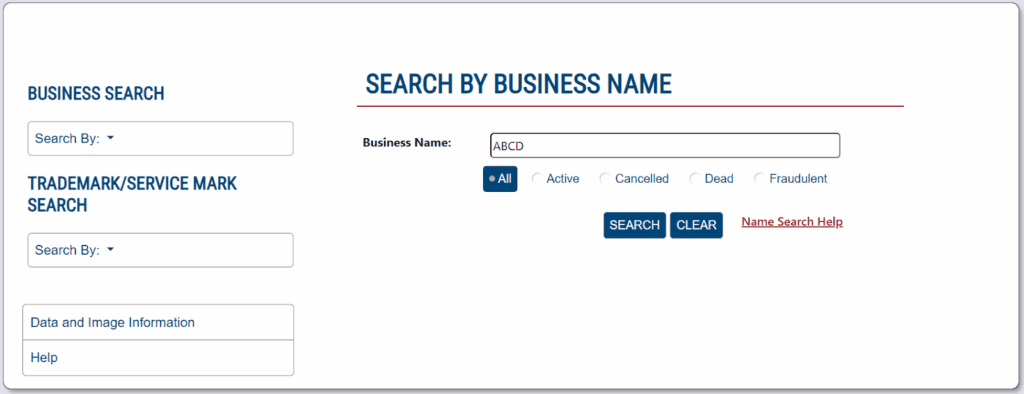
Open businesssearch.ohiosos.gov, pick a search method, type your term, set a status filter, and click Search. Results appear in a table. Click Show Details on any listing to open the full Business Details page. The tool offers seven search methods, so match the method to what you already know.
| Search method | Use it to |
|---|---|
| Business Name | Run a partial or “contains” match on a name |
| Exact Name | Match the precise registered name |
| Prior Business Name | Find an entity under a former name |
| Agent/Registrant | Find entities tied to a statutory agent |
| Organizer/Incorporator | Find entities tied to a founder |
| Number | Look up an entity by its charter number |
| Trademark/Service Mark | Search registered marks |
Source: Ohio SOS Business Search, businesssearch.ohiosos.gov.
The five-step workflow:
- Go to businesssearch.ohiosos.gov, reached from the Businesses tab on the main SOS site.
- Enter your term, then select a search method and status filter.
- Click Search.
- Read the results table: Entity Name, Name Type, Filing Date, Exp. Date, Status, Location, County, State.
- Click Show Details to open the Business Details page and download filing images.
How Do You Check If a Business Name Is Available in Ohio?
Search the tool for your proposed name. If no distinguishable match appears, the name is likely available, with final approval decided at filing. Ohio law requires a new name be “distinguishable upon the records” of the Secretary of State, under Ohio Revised Code (ORC) § 1701.05. The SOS alone decides distinguishability.
Punctuation and entity suffixes do not make a name distinguishable. The Ohio SOS Guide to Name Availability confirms that symbols, articles, abbreviations, and designators such as Co., Corp., Inc., Ltd., and LLC do not distinguish one name from another. “Smith LLC” and “Smith, Inc.” are treated as the same name. Canceled names also stay protected in Hold status for one year after cancellation, so a name that looks free may not be.
Found an available name? Reserve it before you file. The Commenda company name checker runs a quick first pass, and Form 534B holds the name with the state.
| Action | Fee | Notes | Source |
|---|---|---|---|
| Reserve a name (Form 534B) | $39, online or mail | Holds the name 180 days | LSC 2025 SOS fee schedule |
| Transfer or cancel a reservation | $25 | Filed with Form 534B | Ohio SOS Form 534B |
Next step after reserving: how to register a business in Ohio.
How Do You Verify an Ohio Company Is Active?
Open the entity record and read the Status field. Active means the entity is on record as actively engaged in business, in good standing, and authorized to operate in Ohio. Any other status signals a problem. The tool defines five statuses, and each one answers a different question about whether the name is still protected.
| Status | What it means | Name available to others? | Source |
|---|---|---|---|
| Active | On record as actively engaged in business; name protected | No | businesssearch.ohiosos.gov |
| Hold | Canceled by the SOS for failing a legal requirement; name protected | Not for 1 year after cancellation | businesssearch.ohiosos.gov; ORC 1701.922 |
| Canceled | Canceled by the SOS; name not protected | Yes | businesssearch.ohiosos.gov |
| Dead | No longer in business after voluntary dissolution; name not protected | Yes | businesssearch.ohiosos.gov |
| Fraudulent | Filing the Attorney General deemed fraudulent, canceled under Senate Bill 98 | Record reverted or redacted | Ohio SB 98, effective Oct. 24, 2024 |
Hold marks a canceled entity whose name stays protected, not a pending review. The Fraudulent status was added after Senate Bill 98 took effect on October 24, 2024.
What Is an Ohio Charter Number?
An Ohio charter number is the unique entity number the Secretary of State assigns at registration. It also appears as the entity number. The state uses it to identify the business across every filing it makes. You will see it in the results table and at the top of the Business Details page.
Search by it directly with the Number method when you have it. This is the fastest way to pull a single, exact record with no name ambiguity.
What Is a Statutory Agent in Ohio?
A statutory agent is Ohio’s official term for a registered agent. It is the person or company designated to accept service of process, notices, and demands on the business’s behalf. Most states say “registered agent.” Ohio says “statutory agent.” The two terms mean the same thing, and the search uses Ohio’s.
ORC § 1701.07 requires every corporation to maintain one. The agent must be an Ohio-resident individual or an entity with a usual place of business in Ohio. A P.O. box does not qualify. The agent’s address is the address of record for official mail, which is why it matters for due diligence and compliance. Find an entity’s agent on the Business Details page, or search by agent name with the Agent/Registrant method.
What Business Entity Types Appear in Ohio Search Results?
Ohio search results cover every entity type that registers with the Secretary of State, plus sole proprietors and partnerships that filed a trade or fictitious name. Corporations, LLCs, LPs, LLPs, and registered foreign entities all appear. The table shows which types must register and what defines each.
| Entity type | Registers with SOS? | Key trait |
|---|---|---|
| Sole Proprietorship | Only with a trade or fictitious name | One owner, no liability shield |
| General Partnership | Optional (trade name, fictitious name, or Statement of Partnership Authority) | Shared ownership and liability |
| Limited Partnership (LP) | Yes | General partners manage; limited partners’ liability capped |
| Limited Liability Partnership (LLP) | Yes | Liability protection with active management |
| Limited Liability Company (LLC) | Yes | Liability shield, flexible management and tax |
| Corporation (For-Profit, Nonprofit, Benefit) | Yes | Separate legal person, board-governed |
| Professional entity (PC, PLLC) | Yes | For licensed professions |
| Foreign entity | Yes | Formed in another state, registered to operate in Ohio |
Source: Ohio SOS and Ohio Revised Code Chapters 1701, 1702, 1703, and 1706.
Trade name and fictitious name are different filings in Ohio. A trade name grants exclusive rights to the name in Ohio. A fictitious name is registered but grants no exclusive rights.
What Is Foreign Qualification in Ohio?
Foreign qualification is the process by which an out-of-state entity registers with the Ohio SOS before doing business in Ohio. Once qualified, the entity appears in the same search as a domestic one. “Foreign” means formed in another state, not another country.
Two readers need this. If you are vetting an out-of-state company operating in Ohio, its qualification record confirms it is authorized here. If you are expanding into Ohio from elsewhere, you file to qualify. Note one point that trips up sellers: qualifying to do business in a state does not by itself create sales-tax nexus. Nexus requires an actual office, employees, or inventory in the state. Businesses operating across the region often search several states at once, so see the Indiana Business Entity Search and Pennsylvania Business Entity Search guides.
How Do You Get an Ohio Certificate of Good Standing?
Order it through Ohio Business Central. The search shows an entity’s status for free, but the Certificate of Good Standing is a paid official document you must request. It is signed proof that the entity is in good standing with the state.
The certificate name varies by entity type. Ohio may issue it as a Certificate of Full Force and Effect or a Certificate of Continued Existence. You use it to open bank accounts, secure financing, qualify to do business in another state, and close mergers and acquisitions. Confirm the current fee and turnaround on the SOS fee schedule before you order.
How Do You Download Ohio Business Filing Documents?
Open the Business Details page and click the linked filing images. The tool lets you view and download images of an entity’s past filings for free. This is its most underrated feature, and no login is required.
Free images are convenient but not certified. When you need a certified copy for a bank, court, or investor, order it through Ohio Business Central. Mail-in requests use Form 500. Certified copies carry a fee that a free download does not.
How Do You Use the Ohio Business Search for Due Diligence?
Confirm four things before any partnership, purchase, or contract: the exact legal name, the current status, the statutory agent, and the filing history. Together they tell you whether the entity is real, active, and reachable. Pull them from the Business Details page in one sitting.
Use this quick checklist:
- Legal name and charter number: proves the entity exists as named.
- Status: Active confirms good standing; Hold, Canceled, or Dead is a red flag.
- Statutory agent and address: shows where legal notice is served.
- Filing history: reveals lapses, dissolution, or reinstatement.
Know the limits so you do not over-read a clean record. The search does not show ownership or members, financial statements, revenue, or tax standing. Tax details sit with the Ohio Department of Taxation, and business licenses are separate. Beneficial ownership under the federal Corporate Transparency Act (CTA) is a separate regime whose requirements have shifted, so verify its current federal status before relying on it.
How Commenda Simplifies Ohio Entity Management
Your next step after the search is to form, qualify, or stay compliant, and each one has its own filings and deadlines. Commenda’s entity management platform handles all three in one place. It standardizes formation and filings, tracks your statutory agent, and keeps annual and secretarial obligations on schedule, so country 12 behaves like country 1. Every filing is tracked, and every deadline is handled.
Pair it with the Commenda compliance calendar to see every Ohio filing deadline in one view, and the company name checker to clear your name before you file.
Book a demo for a walkthrough of getting an Ohio entity registered and keeping it in good standing, without reopening the laptop at 8pm.